
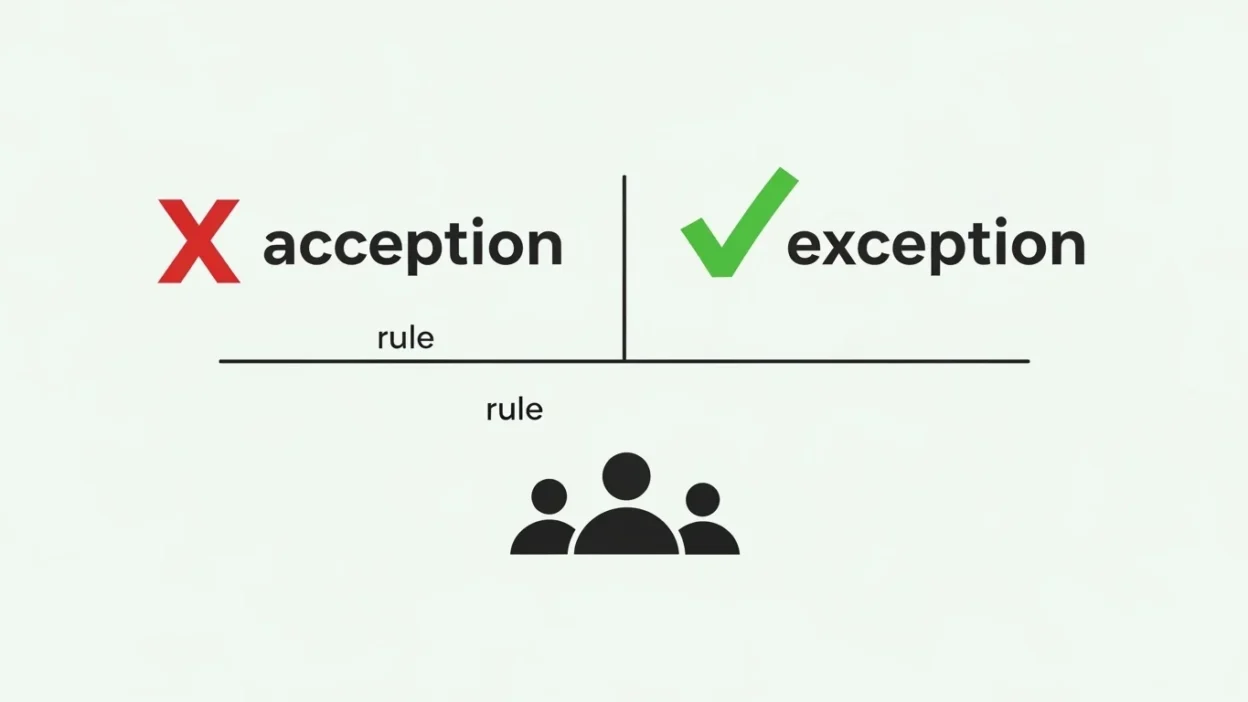
Confused between acception and exception? You’re not alone. These two words look similar, but one is rarely used in modern English while the other is very common and essential.
In this guide, you’ll clearly understand acception vs exception, when to use each, and how to avoid common mistakes.
Quick Answer
- Exception ✅ is common and widely used
- Acception ➖ is rare and mostly outdated
👉 In short:
Exception = something excluded
Acception = meaning/acceptance (rare use)
What Does “Exception” Mean?
Exception is a commonly used noun that refers to something that is excluded from a general rule or statement.
Common Uses of Exception
- Rules and conditions
- Legal or formal contexts
- Everyday speech
Examples of Exception
- Everyone passed the test, with one exception.
- There are no exceptions to this rule.
- She made an exception for him.
Synonyms for Exception
- Exclusion
- Special case
- Deviation
- Irregularity
What Does “Acception” Mean?
Acception is a rare and outdated word. It refers to the meaning of a word or the act of accepting something in a specific sense.
Where You Might See Acception
- Old or historical texts
- Linguistic or philosophical discussions
- Academic or specialized writing
Examples of Acception
- The word has a different acception in this context.
- In its original acception, the term meant something else.
👉 In modern English, people usually say:
- meaning
- sense
instead of acception
Acception vs Exception: Key Differences
| Feature | Exception | Acception |
|---|---|---|
| Usage | Very common | Rare / outdated |
| Meaning | Something excluded | Meaning or sense (rare) |
| Context | Everyday, formal, legal | Academic, historical |
| Example | An exception to the rule | Original acception of a word |
Simple Trick to Remember
Here’s an easy way to keep them straight:
- Exception → “except” → exclude something
- Acception → “accept” → meaning (rare use)
👉 So:
Exception = exclude
Acception = accept/meaning (rare)
Common Mistakes to Avoid
1. Using “Acception” Instead of “Exception”
❌ Incorrect: There is one acception to this rule.
✅ Correct: There is one exception to this rule.
👉 This is the most common error.
2. Thinking Both Words Are Interchangeable
They are not. Acception does not mean exclusion.
3. Overusing “Acception”
In modern English, it’s better to use:
- meaning
- definition
Real-Life Examples
Everyday Conversation
- There’s an exception in this case.
Academic Context
- The original acception of the word differs from modern usage.
Rules and Policies
- No exceptions are allowed.
American vs British English Differences
There is no difference between American and British English:
- Exception is common in both
- Acception is rare in both
Related Words and LSI Keywords
To deepen your understanding:
- Except vs accept
- Exception meaning
- Definition vs meaning
- Grammar confusion words
- Common English mistakes
- Word usage differences
FAQs
What is the difference between acception and exception?
Exception means something excluded, while acception refers to meaning but is rarely used.
Is acception a real word?
Yes, but it is outdated and uncommon in modern English.
Which word should I use in daily writing?
You should almost always use exception.
Can acception replace exception?
No, they have different meanings.
What should I use instead of acception?
Use meaning, sense, or definition.
Is exception used in formal writing?
Yes, it is widely used in both formal and informal contexts.
Why do people confuse these words?
Because they look and sound similar.
Are there regional differences?
No, both words have the same usage in US and UK English.
Summary
The difference between acception vs exception is clear once you understand their usage. Exception is a common and important word used to describe something excluded from a rule. Acception, on the other hand, is rare and mostly outdated, referring to the meaning of a word in a specific context.
In modern English, exception is the word you’ll use almost all the time, while acception is rarely needed.
Final Thoughts
English has many similar-looking words that can easily be confused, and acception vs exception is a great example. By remembering that exception relates to exclusion and is widely used, you can avoid one of the most common mistakes.
Sticking to clear, modern vocabulary not only improves your writing but also ensures your message is easily understood by others.

Sarah Davis is a content writer at BibliHub.com, focused on delivering clear, organized, and easy-to-read articles. Her writing prioritizes simplicity without losing accuracy, helping readers quickly grasp key ideas. Sarah is dedicated to creating content that is informative, reliable, and suitable for a wide audience seeking practical knowledge.