If you’ve ever been confused between emersion vs immersion, you’re definitely not alone. These two words look similar and even share related roots, but they describe opposite actions. Using the wrong one can completely change the meaning of your sentence.
In this guide, you’ll learn the clear difference between emersion and immersion, when to use each, and how to avoid common mistakes. By the end, you’ll feel confident using both words correctly in everyday writing.
Quick Answer
- Immersion means going into something or being deeply involved.
- Emersion means coming out of something, especially from water.
👉 In short:
Immersion = going in
Emersion = coming out
What Does Immersion Mean?
Immersion refers to being completely surrounded by or deeply engaged in something. It can be physical, mental, or emotional.
Common Uses of Immersion
- Language learning (immersion programs)
- Technology (virtual reality immersion)
- Everyday experiences (being immersed in music or books)
Examples of Immersion
- She learned French through full immersion in Paris.
- The diver experienced total immersion in the ocean.
- He was deeply immersed in his studies.
Synonyms for Immersion
- Absorption
- Engagement
- Involvement
- Submersion
What Does Emersion Mean?
Emersion is a less common word that refers to the act of emerging or coming out from something—especially water.
Where Emersion Is Used
- Scientific writing
- Marine biology
- Formal or technical descriptions
Examples of Emersion
- The whale’s emersion thrilled the researchers.
- After minutes underwater, the swimmer’s emersion was a relief.
- The submarine’s emersion was smooth and controlled.
Synonyms for Emersion
- Emergence
- Surfacing
- Appearance
- Rise
Emersion vs Immersion: Key Differences
| Feature | Immersion | Emersion |
|---|---|---|
| Meaning | Going into / deep involvement | Coming out / emerging |
| Usage Frequency | Very common | Rare |
| Context | Education, daily life, technology | Scientific, technical |
| Direction | Inward | Outward |
| Example | Immersion in water | Emersion from water |
Simple Trick to Remember
A quick memory tip:
- Im in immersion → think “in”
- E in emersion → think “exit”
👉 So:
Immersion = in
Emersion = exit
Common Mistakes to Avoid
1. Using Emersion Instead of Immersion
❌ Incorrect: The program offers language emersion.
✅ Correct: The program offers language immersion.
2. Thinking They Are Interchangeable
These words have opposite meanings, so they cannot be swapped.
3. Overusing Emersion in Casual Writing
Emersion is rarely used in everyday English and may sound overly formal or incorrect.
Real-Life Examples
Learning a Language
- Immersion is the best way to gain fluency quickly.
👉 You are fully surrounded by the language.
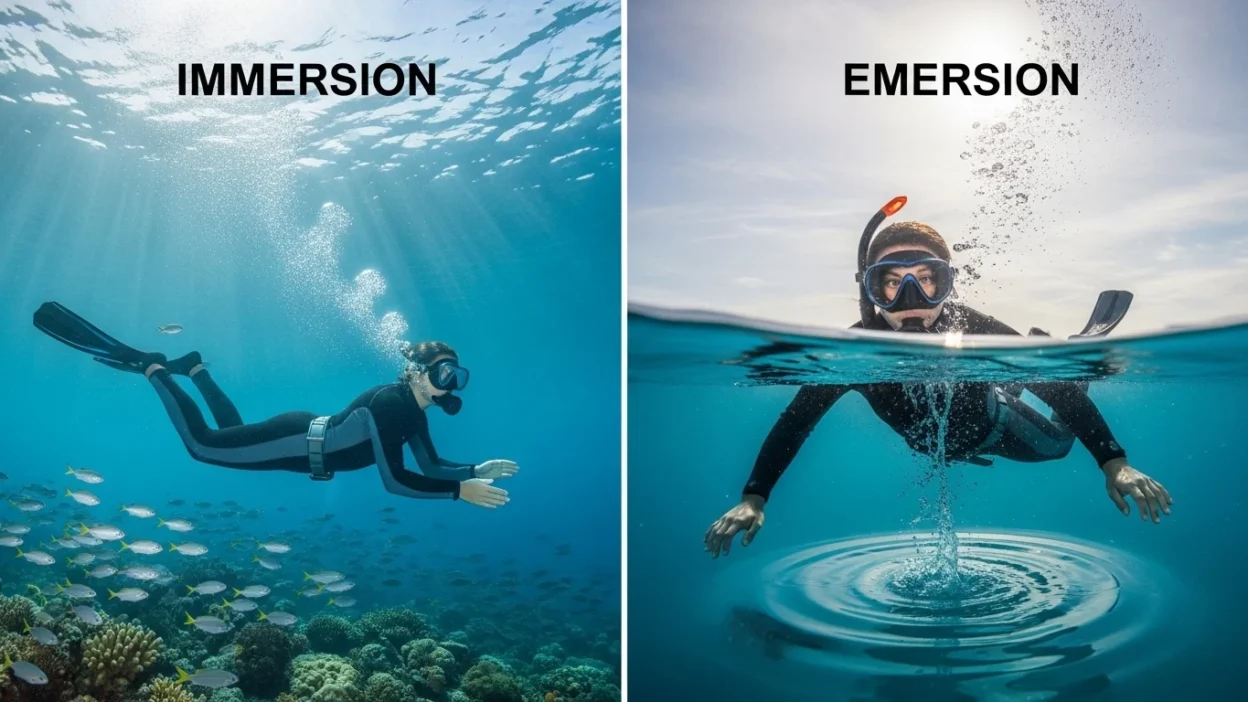
Swimming Context
- Immersion: Going underwater
- Emersion: Coming back to the surface
Technology
- Virtual reality creates a powerful sense of immersion.
American vs British English Differences
There is no difference between American and British English for these words:
- Both use immersion commonly.
- Both recognize emersion as a rare, formal term.
Related Words and LSI Keywords
To improve understanding and context, here are related terms:
- Submersion vs emergence
- Deep engagement
- Cultural immersion
- Language immersion programs
- Surfacing from water
- Being absorbed in something
FAQs
What is the main difference between emersion and immersion?
Immersion means going into something, while emersion means coming out of it.
Is emersion a commonly used word?
No, it is rare and mostly used in scientific or technical contexts.
Can I use emersion instead of immersion?
No, they are not interchangeable and using the wrong one changes the meaning.
What is an example of immersion?
Being fully engaged in a book or living in a country to learn its language.
Does emersion only refer to water?
Mostly, yes. It usually describes emerging from water or a similar substance.
Which word is more common?
Immersion is far more common in everyday language.
Are there synonyms for immersion?
Yes, such as absorption, involvement, and engagement.
Why are these words confusing?
Because they look similar and share related roots but have opposite meanings.
Summary
Understanding emersion vs immersion comes down to direction and context. Immersion is about going into something or being deeply involved—whether physically, mentally, or emotionally. It’s widely used in education, technology, and daily life. In contrast, emersion refers to coming out or emerging, and it’s mostly limited to scientific or formal usage.
Although the words look alike, their meanings are opposite. Remembering this distinction helps you communicate more clearly and avoid common writing errors.
Final Thoughts
Small differences in spelling can carry big differences in meaning, and emersion vs immersion is a perfect example. By focusing on whether the action is inward or outward, you can quickly decide which word fits your sentence.
With practice, these distinctions become intuitive. Paying attention to context and usage not only improves your writing accuracy but also makes your communication more precise and effective.

Emily Johnson is an author at BibliHub.com who specializes in informative and engaging content designed for everyday readers. Her writing style is approachable, organized, and focused on clarity. Emily is passionate about knowledge-sharing and aims to help readers understand topics through concise explanations, helpful examples, and a well-balanced tone that combines professionalism with readability.