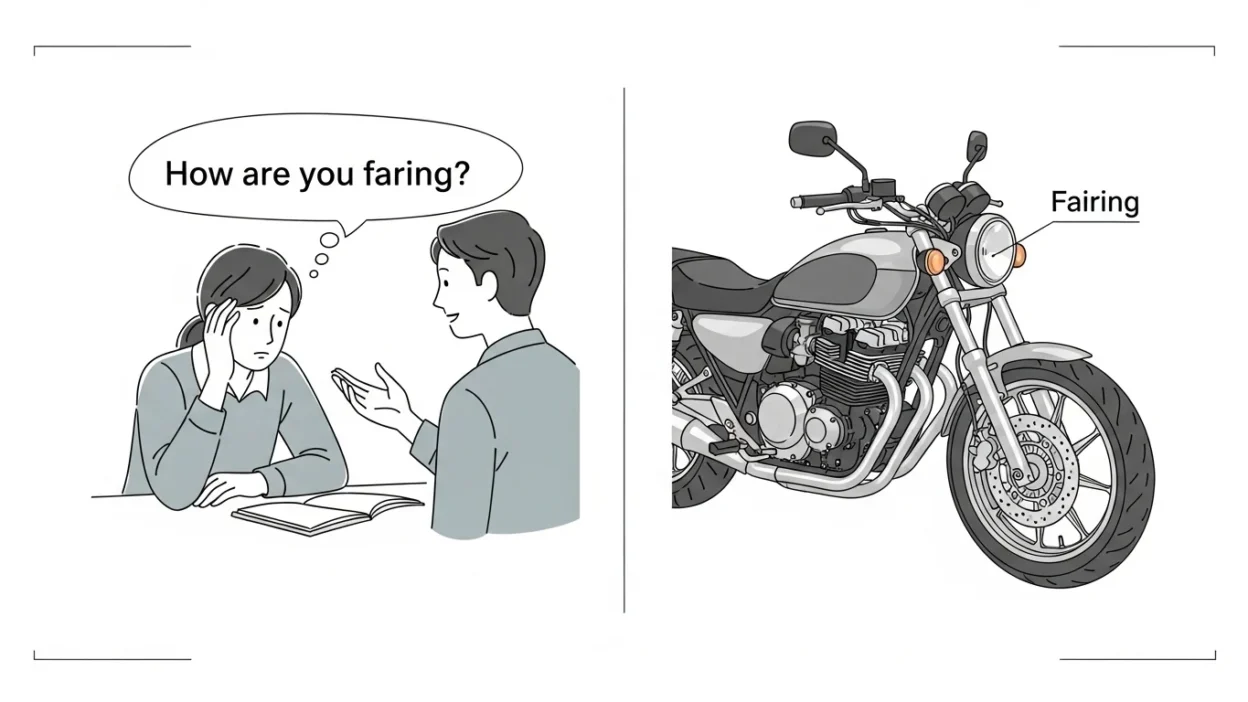
It’s easy to mix up fairing and faring they sound identical but mean completely different things. If you’ve ever paused while writing and wondered which one is correct, you’re not alone. These words are classic homophones, and choosing the right one depends entirely on context.
Let’s break down fairing vs faring in a simple, clear way so you can use each word with confidence.
Quick Answer
- Faring relates to how someone is doing or getting along.
- Fairing refers to a structure or device used to improve aerodynamics.
👉 In short:
Faring = how things are going
Fairing = a physical object (often in engineering)
What Does Faring Mean?
Faring comes from the verb fare, which means to get along, perform, or progress in a certain way.
Common Uses of Faring
- Asking about someone’s well-being
- Describing progress or performance
- Talking about outcomes or situations
Examples of Faring
- How are you faring in your new school?
- The company is faring well despite challenges.
- He is faring better after the treatment.
Synonyms for Faring
- Doing
- Managing
- Progressing
- Getting along
What Does Fairing Mean?
Fairing is a noun used mainly in engineering and design. It refers to a structure added to reduce drag or improve appearance and performance.
Where You’ll See Fairing
- Motorcycles
- Airplanes
- Rockets
- Bicycles
Examples of Fairing
- The motorcycle has a sleek front fairing.
- The rocket’s fairing protects the payload during launch.
- Engineers designed a new fairing to reduce air resistance.
Synonyms for Fairing (Contextual)
- Covering
- Shell
- Casing
- Panel
Fairing vs Faring: Key Differences
| Feature | Faring | Fairing |
|---|---|---|
| Part of Speech | Verb (present participle) | Noun |
| Meaning | How someone is doing | A structural component |
| Context | Everyday conversation | Engineering, mechanics |
| Example | She is faring well | The bike has a front fairing |
Simple Trick to Remember
Here’s an easy memory hack:
- Faring → “fare” (like welfare) → relates to how someone is doing
- Fairing → “air” inside the word → relates to airflow and aerodynamics
👉 So:
Faring = feelings/progress
Fairing = physical object in air/engineering
Common Mistakes to Avoid
1. Using Fairing When Asking About Someone
❌ Incorrect: How are you fairing today?
✅ Correct: How are you faring today?
2. Using Faring in Technical Contexts
❌ Incorrect: The airplane has a new faring design.
✅ Correct: The airplane has a new fairing design.
3. Assuming They Are Interchangeable
Even though they sound the same, these words are not interchangeable.
Real-Life Examples
Everyday Conversation
- How are you faring after your exams?
👉 Asking about progress or well-being.
Business Context
- The startup is faring better this year.
👉 Refers to performance.
Engineering Context
- The new fairing improves the car’s aerodynamics.
👉 Refers to a physical component.
American vs British English Differences
There is no spelling difference between American and British English for these words:
- Faring and fairing are spelled the same in both versions.
- The meanings remain identical across regions.
Related Words and LSI Keywords
To help deepen understanding and improve SEO, here are related terms:
- How are you doing meaning
- Progress and performance
- Aerodynamic design
- Mechanical components
- Structural covering
- Getting along phrase
FAQs
What is the difference between fairing and faring?
Faring refers to how someone is doing, while fairing is a physical structure used in engineering.
Is “how are you fairing” correct?
No, the correct phrase is “how are you faring.”
What does fairing mean in motorcycles?
It refers to the outer shell that improves aerodynamics and protects the rider.
Can faring be used in formal writing?
Yes, faring is acceptable in both formal and informal contexts.
Why are these words confusing?
Because they are homophones—they sound the same but have different meanings and spellings.
Is fairing only used in engineering?
Mostly yes, though it can also refer to shaping or smoothing surfaces in design contexts.
Which word is more commonly used?
Faring is more common in everyday conversation, while fairing is common in technical fields.
Are fairing and faring interchangeable?
No, they have completely different meanings and should not be swapped.
Summary
Understanding fairing vs faring is all about context. Faring is used when talking about how someone is doing or progressing in a situation. It’s common in everyday speech and writing. On the other hand, fairing is a technical term used to describe a physical structure, often in vehicles or machinery, designed to improve aerodynamics.
Although they sound identical, using the wrong one can change the meaning of your sentence entirely. Keeping their roles in mind—faring for progress, fairing for physical objects—will help you avoid mistakes.
Final Thoughts
Language can be tricky, especially when words sound the same but carry entirely different meanings. Fairing vs faring is a perfect example of how small spelling differences can lead to big misunderstandings. By focusing on context—whether you’re talking about performance or a physical object you can easily choose the correct word.
Over time, as you read and write more, these distinctions become second nature. Paying attention to these subtle differences not only improves your accuracy but also makes your communication clearer and more professional.

Michael Brown is a contributor and author at BibliHub.com, where he produces insightful and research-oriented articles. He values depth, accuracy, and structure in his writing, ensuring that readers receive meaningful and well-supported information. Michael’s work is designed to inform, educate, and provide long-term value to readers interested in learning and exploration.