
If you’ve ever hesitated between has ran and has run, you’re not alone. This is a very common grammar confusion—even for fluent English speakers. The good news? The rule is simple once you understand how verb forms work.
In this guide, you’ll learn the correct usage, clear examples, and an easy way to remember it every time.
Quick Answer
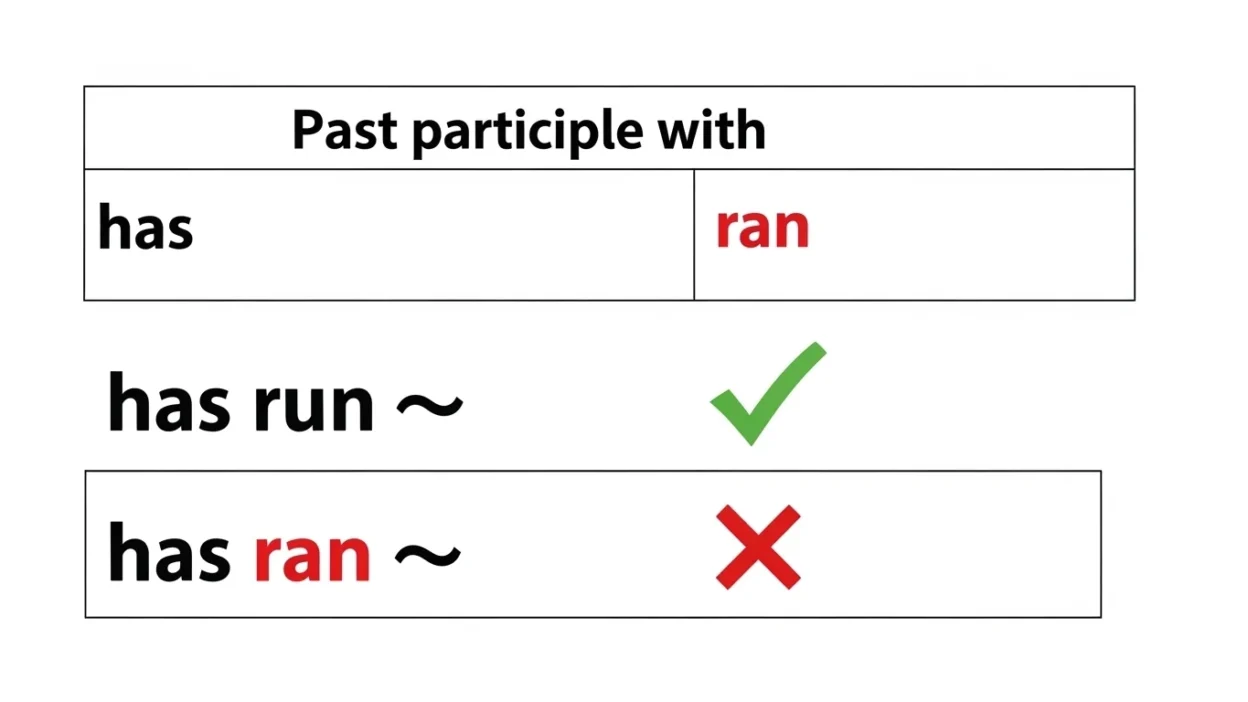
- Has run ✅ is correct
- Has ran ❌ is incorrect
👉 In short:
“Has” + past participle → run (not ran)
Why Is “Has Run” Correct?
The verb run is an irregular verb, which means its forms don’t follow the usual “-ed” pattern.
Verb Forms of “Run”
- Base form: run
- Past simple: ran
- Past participle: run
👉 When you use has / have / had, you must use the past participle form.
Structure
has/have + past participle
✔ Correct: has run
❌ Incorrect: has ran
Examples of “Has Run”
Present Perfect Tense
- She has run five miles today.
- He has run this business for years.
- The program has run successfully.
👉 These sentences connect past actions to the present.
When Do We Use “Ran”?
Ran is the past simple form, used without has/have/had.
Examples of “Ran”
- She ran yesterday.
- He ran very fast in the race.
- They ran to catch the bus.
👉 No helping verb is used here.
Has Ran vs Has Run: Key Differences
| Feature | Has Run | Has Ran |
|---|---|---|
| Grammar | Correct | Incorrect |
| Verb Form | Past participle | Past simple |
| Usage | With has/have/had | Used alone (without has) |
| Example | She has run a marathon | ❌ She has ran a marathon |
Simple Trick to Remember
Here’s an easy way to never get it wrong:
👉 If you see has/have/had → use “run” (not ran)
Think:
“Helping verb = no ‘ran’ allowed.”
Common Mistakes to Avoid
1. Using “Ran” After “Has”
❌ Incorrect: He has ran away.
✅ Correct: He has run away.
2. Mixing Tenses
❌ Incorrect: She has ran yesterday.
✅ Correct: She ran yesterday.
OR
✅ She has run today.
3. Forgetting Irregular Verb Forms
Unlike regular verbs, run doesn’t become runned—so memorization is key.
Real-Life Examples
Everyday Conversation
- I have run out of time.
Work or Professional Context
- The system has run smoothly.
Sports Context
- He has run in many competitions.
American vs British English Differences
There is no difference between American and British English:
- Both use has run as correct
- Has ran is incorrect in both
Related Words and LSI Keywords
To deepen your understanding:
- Run past tense
- Run past participle
- Present perfect tense
- Irregular verbs list
- Has vs have grammar
- Verb forms in English
FAQs
Is “has ran” ever correct?
No, it is always incorrect in standard English.
Why do people say “has ran”?
Because they confuse the past simple (ran) with the past participle (run).
What is the correct form: has ran or has run?
The correct form is has run.
When should I use “ran”?
Use ran in the past simple tense without helping verbs.
What is the past participle of run?
The past participle is run.
Can I say “have ran”?
No, the correct form is have run.
Is this rule the same in British English?
Yes, it’s the same in both US and UK English.
How can I remember this rule easily?
After has/have/had, always use the past participle: run.
Summary
The difference between has ran vs has run comes down to verb forms. Run is an irregular verb, and its past participle is also run. That’s why “has run” is correct, while “has ran” is not.
Understanding this rule helps you avoid a very common grammar mistake and improves your overall sentence accuracy.
Final Thoughts
Mastering small grammar rules like this can make a big difference in how natural your English sounds. Once you remember that “has” always needs a past participle, choosing has run becomes automatic.
With a little practice, you’ll stop second-guessing and start using correct verb forms with confidence.

Sarah Davis is a content writer at BibliHub.com, focused on delivering clear, organized, and easy-to-read articles. Her writing prioritizes simplicity without losing accuracy, helping readers quickly grasp key ideas. Sarah is dedicated to creating content that is informative, reliable, and suitable for a wide audience seeking practical knowledge.