
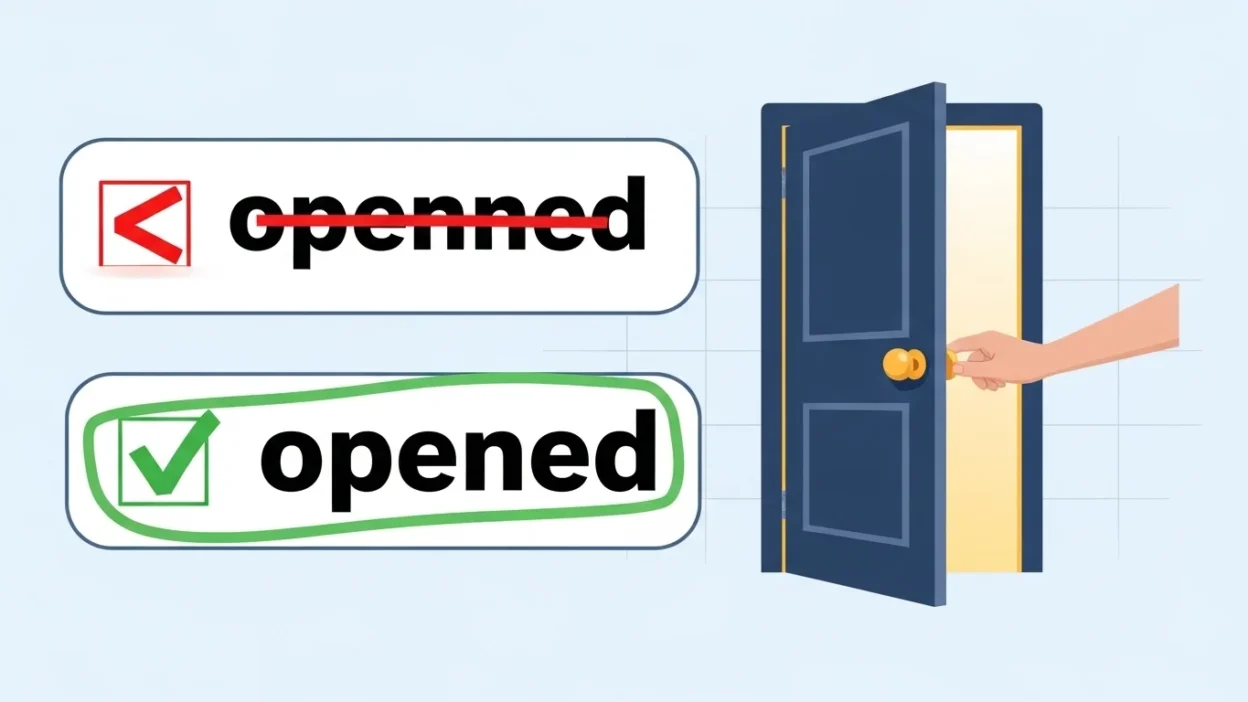
If you’ve ever typed openned and wondered if it’s correct, you’re not alone. This is a very common spelling mistake in English, especially because some verbs double their final consonant in the past tense.
Let’s clearly understand openned vs opened so you can always choose the correct form.
Quick Answer
- Opened ✅ is the correct spelling
- Openned ❌ is incorrect
👉 In short:
Always use “opened.” Never use “openned.”
What Does Opened Mean?
Opened is the past tense and past participle of open. It means to make something accessible, not closed, or ready for use.
Common Uses of Opened
- Doors, windows, or containers
- Businesses or events
- Opportunities or discussions
Examples of Opened
- She opened the door quietly.
- The store opened at 9 a.m.
- He opened his book and started reading.
Synonyms for Opened
- Unlocked
- Uncovered
- Began
- Started
Why Is “Openned” Incorrect?
Many English learners assume that verbs double the final consonant before adding -ed (like plan → planned). But open does NOT follow this rule.
The Rule Explained
- Words only double the final consonant when:
- The stress is on the last syllable, AND
- The word ends in a consonant-vowel-consonant pattern
👉 Open does not meet these conditions:
- It has two syllables (O-pen)
- The stress is on the first syllable
- So, no doubling happens
✔ Correct: open → opened
❌ Incorrect: openned
Openned vs Opened: Key Differences
| Feature | Opened | Openned |
|---|---|---|
| Spelling | Correct | Incorrect |
| Usage | Standard English | Not accepted |
| Grammar Rule | No double “n” | Incorrect doubling |
| Example | She opened the box | ❌ She openned the box |
Simple Trick to Remember
Here’s an easy way to avoid the mistake:
👉 Think: “Open is already complete—no extra ‘n’ needed.”
Or remember:
- If the stress is not on the last syllable, don’t double the consonant.
Common Mistakes to Avoid
1. Doubling the “n”
❌ Incorrect: He openned the window.
✅ Correct: He opened the window.
2. Applying the Rule to All Verbs
Not all verbs double consonants—only specific ones like stop → stopped.
3. Typing Too Quickly
This mistake often happens in fast typing—always proofread important writing.
Real-Life Examples
Everyday Use
- She opened the gift with excitement.
Work or Business
- The company opened a new branch.
School Context
- He opened his notebook and took notes.
American vs British English Differences
There is no difference between American and British English:
- Both use opened as the correct spelling
- Openned is incorrect in both forms
Related Words and LSI Keywords
To strengthen your understanding:
- Open past tense
- Verb spelling rules
- Double consonant rule
- English grammar basics
- Common spelling mistakes
- Irregular vs regular verbs
FAQs
Is openned a real word?
No, openned is not a real word. It is a spelling mistake.
What is the correct spelling: openned or opened?
The correct spelling is opened.
Why don’t we double the “n” in opened?
Because the stress is on the first syllable, so the doubling rule doesn’t apply.
Is opened used in formal writing?
Yes, it is correct in both formal and informal contexts.
Do British and American English differ here?
No, both use opened.
What is a similar example?
Like listen → listened, we do not double the consonant.
Can openned ever be correct?
No, it is always incorrect.
How can I remember the correct spelling?
Remember: open + ed = opened (no double “n”).
Summary
The difference between openned vs opened is simple: only one is correct. Opened is the proper past tense of open and is used in all types of English writing. Openned is a common mistake caused by misunderstanding spelling rules.
Knowing this rule helps you avoid errors and improves the clarity of your writing.
Final Thoughts
English spelling rules can sometimes be confusing, especially when it comes to doubling consonants. However, once you understand that stress plays a key role, choices like opened vs openned become much easier.
Paying attention to these small details can greatly improve your writing accuracy.

Michael Brown is a contributor and author at BibliHub.com, where he produces insightful and research-oriented articles. He values depth, accuracy, and structure in his writing, ensuring that readers receive meaningful and well-supported information. Michael’s work is designed to inform, educate, and provide long-term value to readers interested in learning and exploration.