
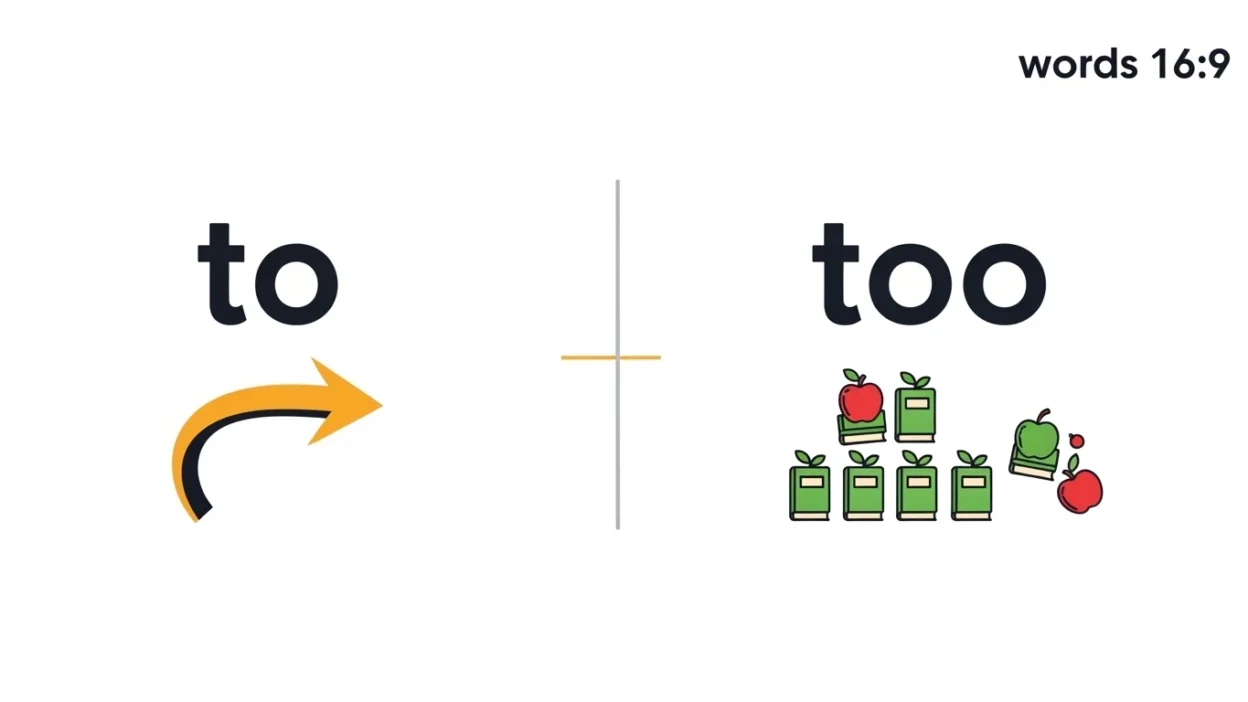
Confused between too vs to? You’re not alone—these two tiny words cause big confusion because they sound exactly the same but have completely different meanings and uses.
In this simple guide, you’ll learn when to use to and when to use too, with clear rules, examples, and easy tricks to remember.
Quick Answer
- To → used as a preposition or part of an infinitive verb
- Too → means also or excessively
👉 In short:
To = direction or purpose
Too = also or too much
What Does “To” Mean?
To is one of the most commonly used words in English. It has several important functions.
1. Showing Direction or Movement
- She is going to the market.
- I walked to school.
👉 Indicates where something is going.
2. Indicating Purpose (Infinitive Form)
- I want to learn English.
- He plans to travel.
👉 Structure: to + base verb
3. Showing Relationship or Connection
- This gift is for you to me.
- He gave the book to his friend.
Synonyms/Related Uses
- Toward
- In the direction of
- For (in some contexts)
What Does “Too” Mean?
Too has a completely different meaning and is used in two main ways.
1. Meaning “Also” or “As Well”
- I want to come too.
- She likes pizza, and I do too.
👉 Adds inclusion.
2. Meaning “Excessively” or “More Than Needed”
- This bag is too heavy.
- It’s too hot outside.
👉 Indicates something is more than enough (often negative).
Synonyms for Too
- Also
- As well
- Excessively
- Overly
Too vs To: Key Differences
| Feature | To | Too |
|---|---|---|
| Meaning | Direction, purpose | Also / excessively |
| Part of Speech | Preposition / infinitive marker | Adverb |
| Usage | Very frequent | Common but specific |
| Example | Go to school | I want to go too |
Simple Trick to Remember
Here’s an easy way to never mix them up:
👉 Too has an extra “o” = extra meaning (also / too much)
👉 If you mean direction or action → use to
Common Mistakes to Avoid
1. Using “To” Instead of “Too”
❌ Incorrect: I want to come to.
✅ Correct: I want to come too.
2. Using “Too” for Direction
❌ Incorrect: She is going too the store.
✅ Correct: She is going to the store.
3. Overusing “Too”
Sometimes people use too when it’s not needed:
❌ He is too very happy.
✅ He is very happy.
Real-Life Examples
Everyday Conversation
- I’m going to the park.
- Can I come too?
Expressing Excess
- This coffee is too hot.
Making Plans
- We are planning to travel.
- She wants to join us too.
American vs British English Differences
There is no difference between American and British English:
- Both use to and too in the same way
- Spelling and meanings are identical
Related Words and LSI Keywords
To deepen your understanding:
- Two vs too vs to
- Common English homophones
- Infinitive verb rules
- English grammar basics
- Also vs too difference
- Prepositions in English
FAQs
What is the difference between to and too?
To shows direction or purpose, while too means also or excessively.
Can I use “too” instead of “to”?
No, they are not interchangeable.
What does “too” mean in a sentence?
It means also or more than enough.
Is “to” used before verbs?
Yes, in infinitive form like to eat, to go.
What is a simple way to remember “too”?
It has an extra “o,” meaning something extra.
Are to and too pronounced the same?
Yes, they are homophones.
Can “too” start a sentence?
Yes, but it’s less common. Example: Too many people were there.
Is there a difference in UK and US English?
No, usage is the same in both.
Summary
The difference between too vs to is simple once you understand their roles. To is used for direction, purpose, or as part of a verb, while too is used to mean also or more than enough. Even though they sound the same, their meanings are completely different.
Learning this distinction helps you avoid common grammar mistakes and makes your writing clearer and more accurate.
Final Thoughts
Small words like to and too may seem simple, but they play a big role in clear communication. By remembering that too has an extra “o” for something extra, you can quickly choose the correct word in any sentence.
With regular practice, using to vs too correctly will become natural, improving both your writing and speaking skills.

John Miller is a content author at BibliHub.com, known for creating clear, well-structured, and reader-friendly articles. He focuses on breaking down complex topics into simple, practical explanations that are easy to understand for a global audience. John emphasizes accuracy, research-based information, and logical presentation, making his work reliable and accessible for readers seeking trustworthy knowledge.