The words forgo and forego look very similar, but they have different meanings and uses. This confusion is extremely common, especially in writing.
This complete guide will help you understand forgo vs forego clearly with rules, examples, and simple memory tricks.
Quick Answer
- Forgo → to give up, skip, or go without something
- Forego → to go before or precede (rare use)
👉 In short:
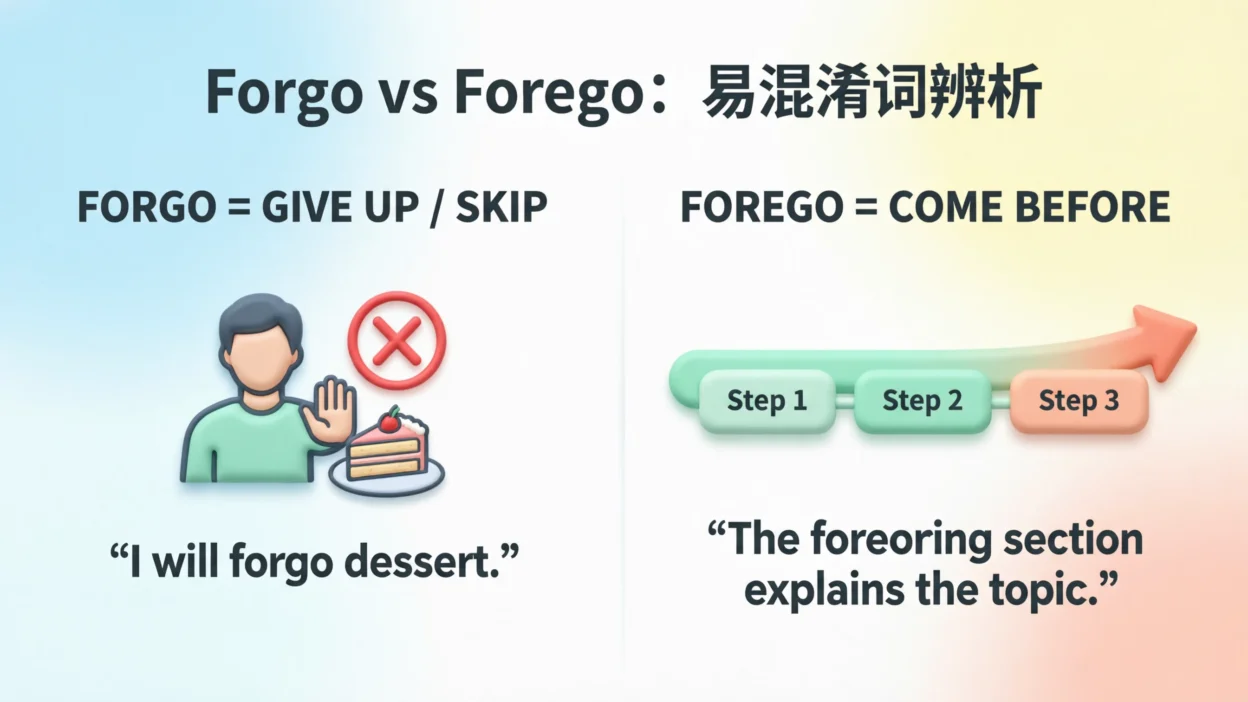
Forgo = give up
Forego = come before
What Does “Forgo” Mean?
Forgo means to choose not to have something, to give it up, or to skip it.
It is the most commonly used word between the two.
When to Use “Forgo”
- Giving something up voluntarily
- Skipping an option or opportunity
- Choosing not to take something
Examples of Forgo
- I will forgo dessert tonight.
- She decided to forgo the job offer.
- He chose to forgo luxury to save money.
- They had to forgo their vacation.
👉 This is the word you will use in everyday English.
What Does “Forego” Mean?
Forego means to go before, precede, or come earlier than something else.
It is rare in modern English and mostly appears in formal or fixed expressions.
When to Use “Forego”
- Formal writing
- Referring to something mentioned earlier
- Fixed phrases
Examples of Forego
- The foregoing paragraph explains the issue.
- The results depend on the foregoing discussion.
- It was a foregone conclusion.
👉 You will rarely need this word in daily use.
Important Note: “Foregone Conclusion”
One very common phrase uses forego:
👉 Foregone conclusion = something already decided or predictable
✔ Example:
- Their victory was a foregone conclusion.
❌ Not: forgone conclusion
Forgo vs Forego: Key Differences
| Feature | Forgo | Forego |
|---|---|---|
| Meaning | Give up / go without | Go before / precede |
| Usage | Very common | Rare / formal |
| Context | Everyday English | Formal or legal writing |
| Example | Forgo lunch | Foregoing statement |
Simple Trick to Remember
👉 Forgo = forget → give up
👉 Forego = “fore” = before
Think:
- skip something → forgo ✔
- before something → forego ✔
Common Mistakes to Avoid
1. Using “Forego” Instead of “Forgo”
❌ I will forego coffee
✅ I will forgo coffee
2. Confusing “Foregone” with “Forgone”
✔ Foregone conclusion
❌ Forgone conclusion
3. Overusing “Forego”
Most of the time, you should use forgo.
Real-Life Examples
Everyday Use
- He decided to forgo the opportunity.
- She will forgo buying a new phone.
Formal Use
- The foregoing section outlines the policy.
- The outcome was a foregone conclusion.
American vs British English
There is no major difference:
- Both prefer forgo in daily use
- Forego is formal in both
Related Words and LSI Keywords
- Forgo meaning
- Forego definition
- Foregone conclusion meaning
- Common English mistakes
- Vocabulary differences
- English grammar tips
FAQs
Which is correct: forgo or forego?
Both are correct, but used differently.
Which one should I use most of the time?
Use forgo.
What does forego mean?
It means to come before or precede.
Is forego outdated?
Not outdated, but rare.
What is a foregone conclusion?
Something already decided or obvious.
Are they interchangeable?
No, meanings are different.
Is this a common mistake?
Yes, very common.
Is there a UK vs US difference?
No, same usage.
Summary
The difference between forgo vs forego is meaning and usage. Forgo means to give something up and is commonly used, while forego means to come before and is rare.
Final Thoughts
Even though these words look almost identical, their meanings are quite different. In modern English, forgo is the word you’ll use most often. Remembering that fore = before will help you avoid confusion.
Master this distinction, and your writing will be clearer and more accurate.

John Miller is a content author at BibliHub.com, known for creating clear, well-structured, and reader-friendly articles. He focuses on breaking down complex topics into simple, practical explanations that are easy to understand for a global audience. John emphasizes accuracy, research-based information, and logical presentation, making his work reliable and accessible for readers seeking trustworthy knowledge.