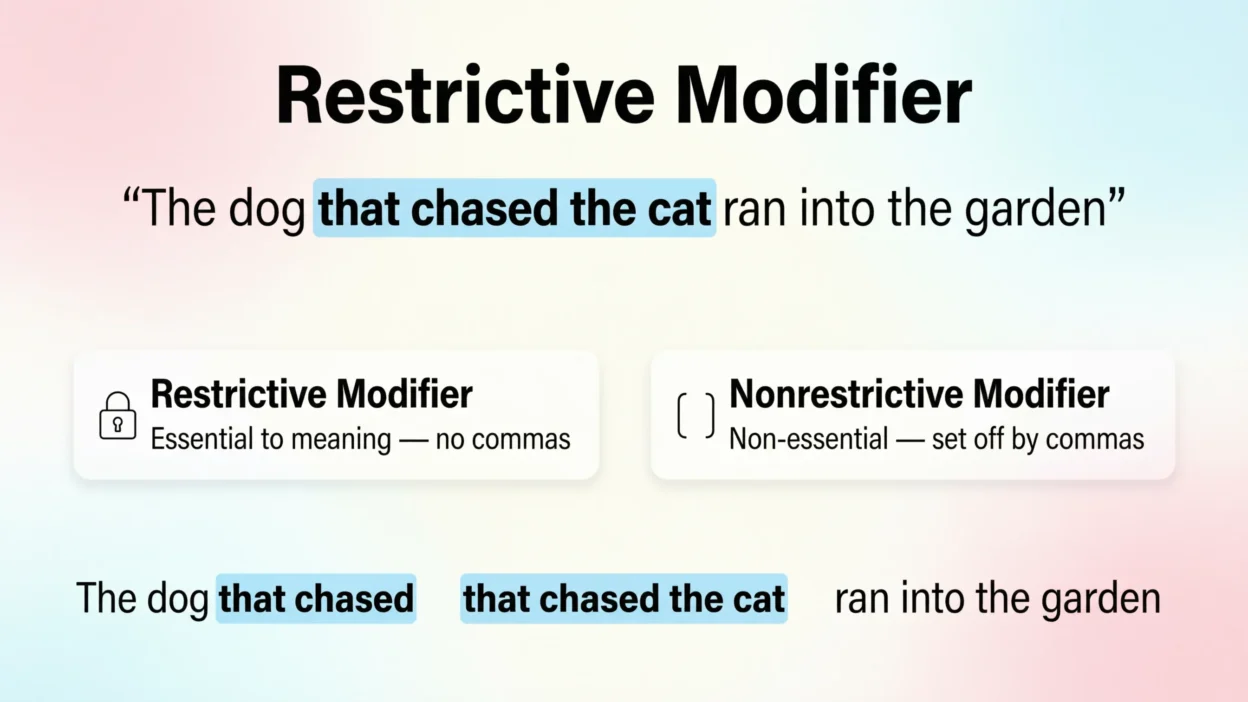
A restrictive modifier is a word, phrase, or clause that provides essential information about a noun. Without it, the sentence’s meaning would change or become unclear.
👉 It is also called an essential modifier.
Quick Definition
A restrictive modifier:
- Limits or identifies a noun
- Gives necessary information
- Is not separated by commas
Example
- Students who study regularly usually perform better.
👉 The phrase “who study regularly” tells us which students.
Without it:
- Students usually perform better.
The meaning becomes broader and less specific.
How Restrictive Modifiers Work
A restrictive modifier narrows down the meaning of a noun.
It answers questions like:
- Which one?
- What kind?
- Which people/things?
Examples of Restrictive Modifiers
Restrictive Clause
- The book that I borrowed is excellent.
👉 “that I borrowed” identifies which book.
Restrictive Phrase
- People with tickets may enter first.
👉 “with tickets” identifies which people.
Restrictive Adjective
- The red car belongs to Sarah.
👉 “red” specifies which car.
Restrictive vs Nonrestrictive Modifiers
| Feature | Restrictive Modifier | Nonrestrictive Modifier |
|---|---|---|
| Information | Essential | Extra/nonessential |
| Commas | No commas | Uses commas |
| Meaning Without Modifier | Changes or unclear | Still clear |
Example Comparison
Restrictive
- My friend who lives in Lahore is visiting.
👉 Suggests I have multiple friends.
Nonrestrictive
- My friend, who lives in Lahore, is visiting.
👉 Suggests I have one specific friend.
Comma Rule
Restrictive modifiers:
❌ No commas
Nonrestrictive modifiers:
✔ Use commas
Common Restrictive Modifier Words
- that
- who
- whom
- whose
- which (sometimes in British English)
Simple Trick to Remember
👉 If removing the modifier changes the meaning significantly, it is restrictive.
Common Mistakes to Avoid
1. Adding Unnecessary Commas
❌ The students, who studied, passed the exam.
⚠️ This changes the meaning.
✅ The students who studied passed the exam.
2. Confusing Essential and Extra Information
Ask:
👉 Is this information necessary to identify the noun?
3. Overusing “Which”
In American English:
- that is often preferred for restrictive clauses.
Example:
✔ The car that I bought is blue.
Real-Life Examples
- Employees who arrive late may lose pay.
- The movie that we watched was exciting.
- Dogs with long fur need grooming.
American vs British English
- American English often prefers that for restrictive clauses
- British English may use which more freely
FAQs
What is a restrictive modifier?
A modifier that gives essential information about a noun.
Do restrictive modifiers use commas?
No.
What happens if you remove a restrictive modifier?
The sentence meaning changes or becomes unclear.
Is a restrictive clause the same thing?
Yes, it is one type of restrictive modifier.
Is this an important grammar rule?
Yes.
Summary
- Restrictive modifiers give essential information
- They identify or limit nouns
- They do not use commas
Final Thoughts
Understanding restrictive modifiers helps improve sentence clarity and punctuation. The key idea is simple: if the information is necessary to identify the noun, the modifier is restrictive and should not be separated by commas.

John Miller is a content author at BibliHub.com, known for creating clear, well-structured, and reader-friendly articles. He focuses on breaking down complex topics into simple, practical explanations that are easy to understand for a global audience. John emphasizes accuracy, research-based information, and logical presentation, making his work reliable and accessible for readers seeking trustworthy knowledge.