Confused between when I can and when can I? These phrases look similar, but they follow different grammar rules and are used in different situations.
This guide explains when I can vs when can I with simple rules, examples, and tips.
Quick Answer
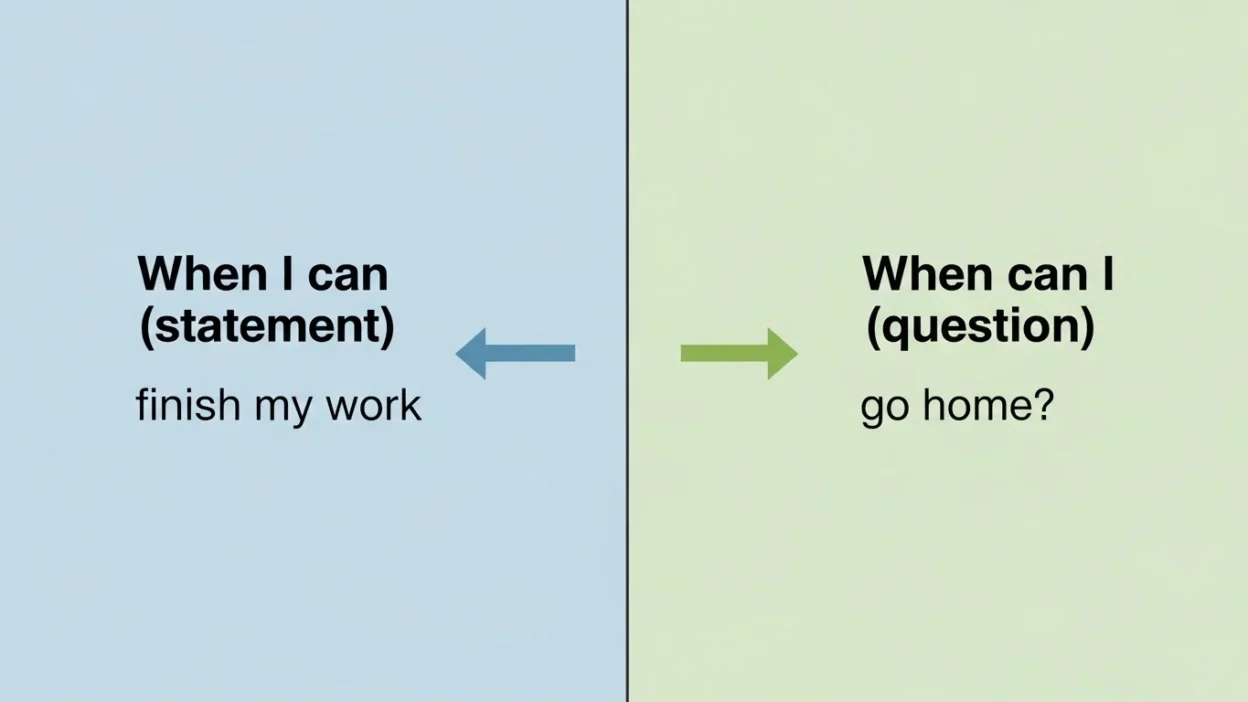
- When I can → used in statements
- When can I → used in questions
👉 In short:
I can = statement
Can I = question
What Does “When I Can” Mean?
When I can is used in a statement. It means at the time I am able to do something.
When to Use “When I Can”
- In sentences (not questions)
- To talk about availability or possibility
Examples of When I Can
- I will call you when I can.
- I’ll help you when I can.
- I visit them when I can.
👉 It expresses ability or opportunity.
What Does “When Can I” Mean?
When can I is used in a question. It asks about the time something is possible.
When to Use “When Can I”
- Asking for permission or timing
- Asking about availability
Examples of When Can I
- When can I start the job?
- When can I see you?
- When can I submit the form?
👉 It’s used to ask about timing or permission.
When I Can vs When Can I: Key Differences
| Feature | When I Can | When Can I |
|---|---|---|
| Type | Statement | Question |
| Structure | Subject + verb | Verb + subject (inversion) |
| Meaning | Ability or possibility | Asking about time/permission |
| Example | I’ll go when I can | When can I go? |
Simple Trick to Remember
Here’s an easy way to choose:
👉 Question = verb first (Can I)
👉 Statement = subject first (I can)
Think:
- Can I? → asking
- I can → telling
Common Mistakes to Avoid
1. Using Question Form in a Statement
❌ Incorrect: I will come when can I.
✅ Correct: I will come when I can.
2. Using Statement Form as a Question
❌ Incorrect: When I can start?
✅ Correct: When can I start?
3. Forgetting Word Order
English questions require inversion (verb before subject).
Real-Life Examples
Everyday Statements
- I’ll finish the work when I can.
Asking Questions
- When can I leave?
Polite Requests
- When can I talk to you?
American vs British English Differences
There is no difference:
- Both American and British English use these forms the same way
- The rule depends on grammar, not region
Related Words and LSI Keywords
To deepen your understanding:
- Can I vs I can
- English question structure
- Subject-verb inversion
- Grammar rules for questions
- Common sentence mistakes
- English speaking tips
FAQs
What is the difference between when I can and when can I?
When I can is a statement, while when can I is a question.
Which is correct in a sentence?
Use when I can in statements.
Which is correct in a question?
Use when can I.
Why is word order different?
Questions require verb before subject.
Can I use when I can in a question?
No, it would be incorrect.
Is this the same in UK and US English?
Yes, there is no difference.
How can I remember the rule?
Think: question = can I, statement = I can.
Is this a common mistake?
Yes, especially for learners of English.
Summary
The difference between when I can vs when can I comes down to sentence type. When I can is used in statements, while when can I is used in questions.
Understanding this simple rule helps you form correct and natural sentences.
Final Thoughts
Small changes in word order can completely change meaning in English. By remembering that questions flip the verb and subject, you can easily choose the right form.
With practice, using when I can and when can I correctly will become automatic.

Sarah Davis is a content writer at BibliHub.com, focused on delivering clear, organized, and easy-to-read articles. Her writing prioritizes simplicity without losing accuracy, helping readers quickly grasp key ideas. Sarah is dedicated to creating content that is informative, reliable, and suitable for a wide audience seeking practical knowledge.