Elegy and eulogy are often confused because both relate to death and remembrance but they’re used in very different ways.
This guide explains elegy vs eulogy clearly so you can choose the right word.
Quick Answer
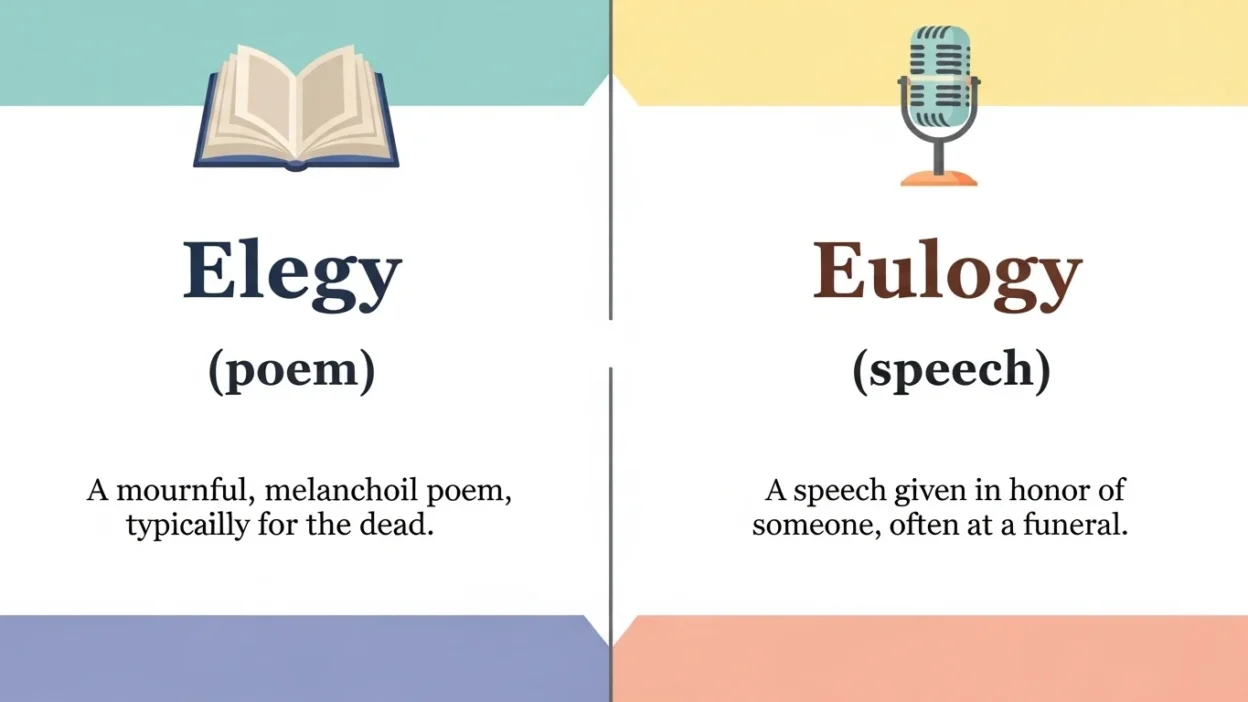
- Elegy → a poem or written piece mourning someone
- Eulogy → a speech praising someone, usually at a funeral
👉 In short:
Elegy = written tribute
Eulogy = spoken tribute
What Does “Elegy” Mean?
An elegy is a poem or reflective piece written to mourn or honor someone who has died.
When to Use “Elegy”
- Poetry or literature
- Emotional reflection
- Artistic expression of grief
Examples of Elegy
- He wrote an elegy for his late friend.
- The poem is a beautiful elegy for lost love.
👉 It’s usually written and literary.
What Does “Eulogy” Mean?
A eulogy is a speech or spoken tribute that praises someone’s life, often delivered at a funeral.
When to Use “Eulogy”
- Funerals or memorial services
- Public speaking
- Honoring someone’s life
Examples of Eulogy
- She gave a touching eulogy at the funeral.
- His eulogy celebrated her achievements.
👉 It’s typically spoken aloud.
Elegy vs Eulogy: Key Differences
| Feature | Elegy | Eulogy |
|---|---|---|
| Form | Written (poem or text) | Spoken (speech) |
| Purpose | Mourning / reflection | Praise / tribute |
| Context | Literature | Funerals, ceremonies |
| Tone | Emotional, reflective | Respectful, celebratory |
Simple Trick to Remember
👉 Elegy = literature (poem)
👉 Eulogy = you speak (speech)
Think:
- elegy → emotional writing
- eulogy → spoken tribute
Common Mistakes to Avoid
1. Using Them Interchangeably
❌ He gave an elegy at the funeral
✅ He gave a eulogy at the funeral
2. Confusing Written vs Spoken
Remember:
- written → elegy
- spoken → eulogy
3. Ignoring Context
Funeral speech = eulogy, not elegy.
Real-Life Examples
Literary Context
- The poet composed an elegy.
Funeral Context
- She delivered a heartfelt eulogy.
General Use
- The novel reads like an elegy for a lost era.
American vs British English Differences
There is no difference:
- Both words are used the same way in US and UK English
Related Words and LSI Keywords
- Funeral speech meaning
- Tribute writing
- Mourning literature
- Memorial speech
- Poetic forms
- English vocabulary differences
FAQs
What is the difference between elegy and eulogy?
An elegy is written, while a eulogy is spoken.
Which is used at funerals?
Eulogy is used as a speech.
Can an elegy be spoken?
It can be read aloud, but it’s still a written form.
Which is more emotional?
Both can be emotional, but elegies are more reflective.
Are they interchangeable?
No, they serve different purposes.
Is there a difference in UK and US English?
No, meanings are the same.
How can I remember the difference?
Think: eulogy = you speak.
Is this a common confusion?
Yes, due to similar spelling and context.
Summary
The difference between elegy vs eulogy lies in form and use. Elegy is a written piece of mourning, while eulogy is a spoken tribute, usually at a funeral.
Final Thoughts
Although both words honor someone who has passed, they belong to different forms of expression writing vs speaking. Understanding this distinction helps you use each word accurately and respectfully.

Sarah Davis is a content writer at BibliHub.com, focused on delivering clear, organized, and easy-to-read articles. Her writing prioritizes simplicity without losing accuracy, helping readers quickly grasp key ideas. Sarah is dedicated to creating content that is informative, reliable, and suitable for a wide audience seeking practical knowledge.