Choosing between whole day and all day can be confusing. Both are understandable, but one sounds more natural and correct in modern English.
This guide explains whole day vs all day clearly so you can use the right phrase confidently.
Quick Answer
- All day ✅ most natural and common
- Whole day ⚠️ less common, slightly awkward alone
👉 In short:
Use “all day” in most situations
What Does “All Day” Mean?
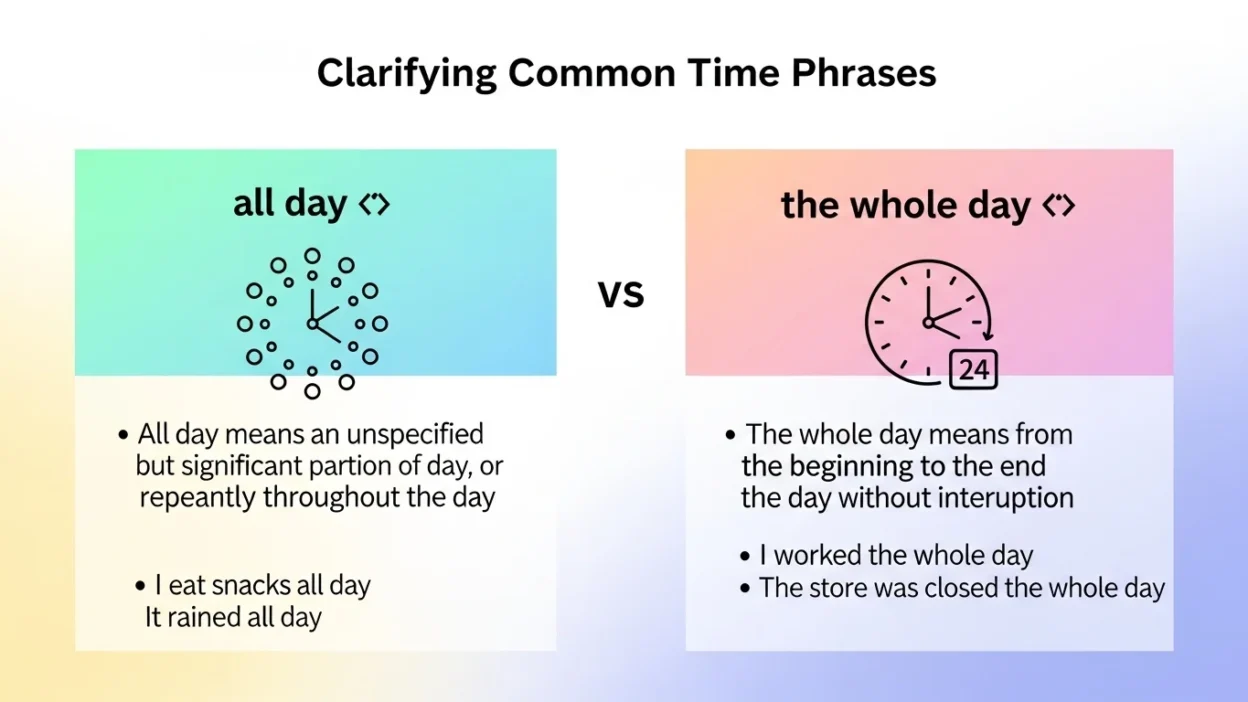
All day means throughout the entire day, from start to finish.
When to Use “All Day”
- Everyday conversation
- Describing duration
- Natural, fluent English
Examples of All Day
- I was busy all day.
- It rained all day.
- She worked all day without a break.
👉 It’s the most common and natural choice.
What Does “Whole Day” Mean?
Whole day means the entire day, but it is usually used with an article:
👉 “the whole day” ✔ (correct)
👉 “whole day” alone ❌ sounds incomplete
When to Use “The Whole Day”
- When emphasizing the entire duration
- Slightly more formal or descriptive tone
Examples of The Whole Day
- I was tired the whole day.
- He stayed home the whole day.
👉 It works, but is less common than all day.
Whole Day vs All Day: Key Differences
| Feature | All Day | (The) Whole Day |
|---|---|---|
| Usage | Very common | Less common |
| Structure | Used alone | Needs “the” |
| Tone | Natural | Slightly formal/emphatic |
| Example | I slept all day | I slept the whole day |
Simple Trick to Remember
👉 Casual, natural English → all day
👉 More emphasis → the whole day
Think:
- everyday speech → all day ✔
Common Mistakes to Avoid
1. Using “Whole Day” Without “The”
❌ I worked whole day
✅ I worked all day
✅ I worked the whole day
2. Overusing Formal Structure
“All day” is usually smoother and more natural.
3. Mixing Both in One Sentence
Stick to one phrase.
Real-Life Examples
Everyday Conversation
- I’ve been waiting all day.
Emphasis
- He complained the whole day.
Work Context
- She studied all day for the exam.
American vs British English Differences
There is no major difference:
- Both prefer all day in everyday use
- “The whole day” is accepted in both
Related Words and LSI Keywords
- All night vs whole night
- Entire day meaning
- Duration expressions
- English fluency tips
- Natural English phrases
- Common grammar mistakes
FAQs
Which is correct: whole day or all day?
All day is more natural.
Can I say whole day?
Only with “the” → the whole day.
Why is all day more common?
Because it’s shorter and more natural in speech.
Is the whole day wrong?
No, it’s correct but less common.
Which should I use in writing?
Use all day for most cases.
Is there a difference in UK and US English?
No major difference.
How can I remember the rule?
Think: natural speech = all day.
Is this a common mistake?
Yes, especially for learners.
Summary
The difference between whole day vs all day is mainly about natural usage. All day is the most common and fluent expression, while the whole day is correct but less frequently used.
Final Thoughts
When in doubt, go with all day—it sounds natural, simple, and correct in almost every situation. While the whole day adds emphasis, it’s not needed most of the time.
Choosing the simpler option often leads to clearer and more natural English.

John Miller is a content author at BibliHub.com, known for creating clear, well-structured, and reader-friendly articles. He focuses on breaking down complex topics into simple, practical explanations that are easy to understand for a global audience. John emphasizes accuracy, research-based information, and logical presentation, making his work reliable and accessible for readers seeking trustworthy knowledge.