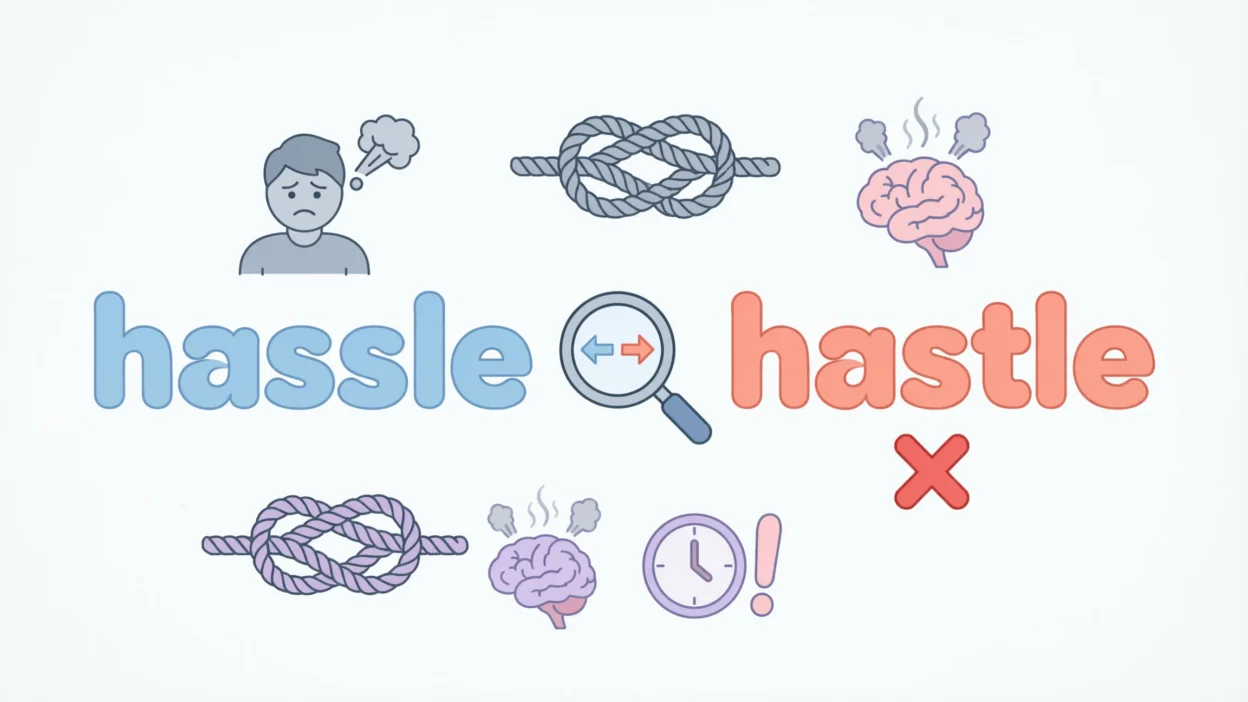
Many people get confused between hastle and hassle, but only one of these is a real English word.
Quick Answer
- Hassle ✅ correct
- Hastle ❌ incorrect
👉 In short:
Always use “hassle”
What Does “Hassle” Mean?
Hassle means trouble, inconvenience, or something annoying.
It can be used as both a noun and a verb.
As a Noun (Thing)
- This is too much of a hassle.
- Traveling in traffic is a real hassle.
As a Verb (Action)
- Don’t hassle me right now.
- He was hassled by security at the airport.
👉 It’s commonly used in everyday English.
Why “Hastle” Is Wrong
❌ Hastle is not a correct English word
It’s usually:
- A spelling mistake
- Confused with words like hustle or castle
👉 You should never use it.
Hassle vs Hastle: Key Differences
| Feature | Hassle | Hastle |
|---|---|---|
| Spelling | Correct | Incorrect |
| Meaning | Trouble / inconvenience | ❌ No meaning |
| Usage | Common | Not used |
Simple Trick to Remember
👉 Hassle = double “s” like “stress” ✔
Common Mistakes to Avoid
1. Adding an Extra “T”
❌ This is a hastle
✅ This is a hassle
2. Confusing with “Hustle”
- Hustle = work hard / move quickly
- Hassle = trouble
3. Typing Too Fast
This mistake often happens in texting or casual writing.
Real-Life Examples
- Filling out forms can be a hassle.
- I don’t want the hassle of moving again.
- Stop hassling me!
American vs British English
There is no difference:
- Both use hassle
- “Hastle” is incorrect everywhere
FAQs
Which is correct: hastle or hassle?
Hassle is correct.
Is hastle a real word?
No.
What does hassle mean?
Trouble, inconvenience, or annoyance.
Is hassle formal?
It’s mostly informal but widely accepted.
Is this a common mistake?
Yes, very common.
Summary
The correct spelling is hassle, meaning trouble or inconvenience. Hastle is incorrect and should not be used.
Final Thoughts
Spelling mistakes like this are easy to fix once you know the rule. Just remember the double “s” in hassle, and you’ll never get it wrong again.

Michael Brown is a contributor and author at BibliHub.com, where he produces insightful and research-oriented articles. He values depth, accuracy, and structure in his writing, ensuring that readers receive meaningful and well-supported information. Michael’s work is designed to inform, educate, and provide long-term value to readers interested in learning and exploration.