The words “resister” and “resistor” look and sound very similar, but they belong to completely different subjects. One refers to a person who opposes something, while the other is a technical term used in electronics.
Quick Answer
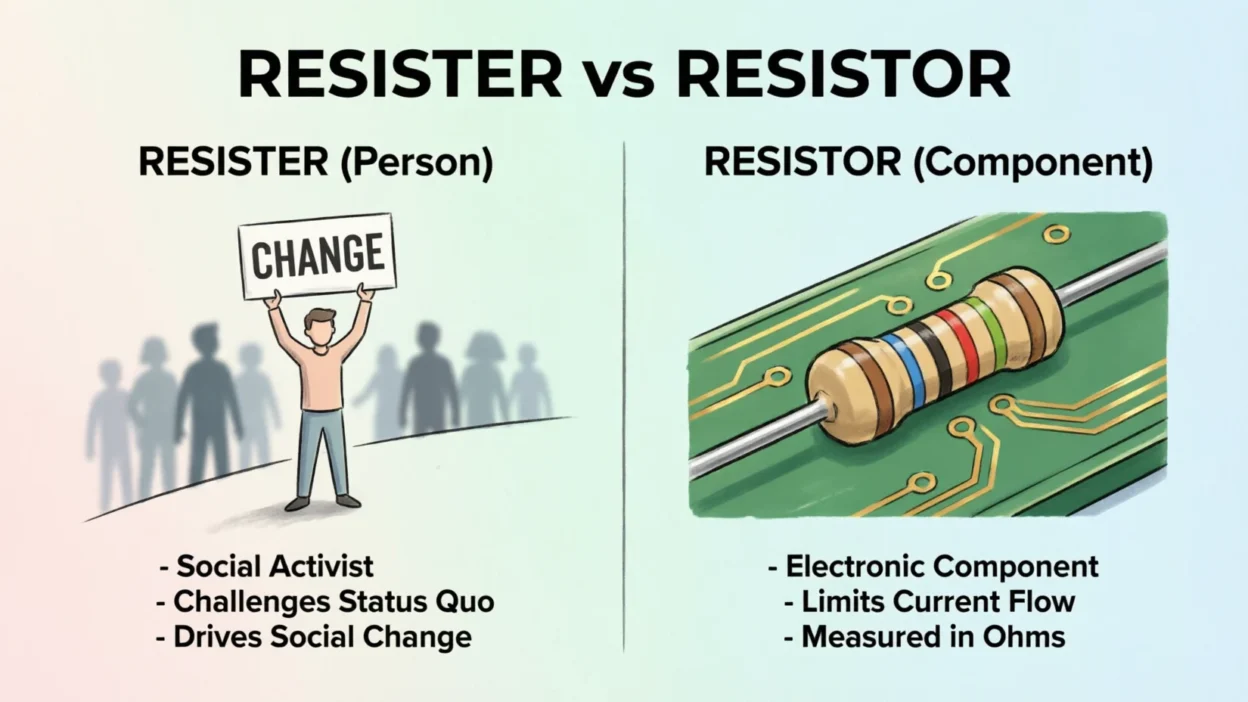
- Resister → a person who resists or opposes something
- Resistor → an electrical component that controls current
👉 In simple terms:
Resister = human opposition ✊
Resistor = electronic device ⚡
What Does “Resister” Mean?
A resister is:
👉 someone who refuses, opposes, or fights against something.
The word often appears in:
- politics
- activism
- military history
- social movements
Examples
- The brave resisters fought against oppression.
- He became a tax resister after the new law passed.
- The movement honored its early resisters.
The word is connected to:
- resistance
- protest
- refusal
- opposition
What Does “Resistor” Mean?
A resistor is:
👉 an electronic component designed to limit or regulate electrical current in a circuit.
It is commonly used in:
- electronics
- engineering
- electrical systems
- physics
Examples
- The technician replaced the burned resistor.
- Every circuit board contains multiple resistors.
- The resistor helped control the voltage safely.
A resistor’s main purpose is to:
- reduce current flow
- protect components
- manage electrical signals
Resister vs Resistor: Key Differences
| Feature | Resister | Resistor |
|---|---|---|
| Meaning | Person who opposes | Electrical component |
| Subject Area | Politics/social issues | Electronics/engineering |
| Type | Human noun | Technical device |
| Main Function | Resistance/opposition | Current control |
Pronunciation Difference
The words sound extremely similar:
- Resister → ree-ZISS-ter
- Resistor → ree-ZISS-ter
Because of this, spelling confusion is very common.
Simple Trick to Remember
👉 ResistER = person 👤
👉 ResistOR = object/device ⚡
Another easy memory trick:
- many machine/device words end in -or
- motor
- generator
- projector
- resistor
Common Uses of “Resister”
Political Context
- war resister
- draft resister
- political resister
Social Activism
- civil rights resister
- government resister
Sometimes English speakers use alternatives like:
- protester
- dissenter
- activist
- opponent
depending on the context.
Common Uses of “Resistor”
Electronics
- carbon resistor
- fixed resistor
- variable resistor
Engineering
- circuit design
- electrical repair
- voltage regulation
Resistors are basic components in:
- computers
- phones
- televisions
- power supplies
Common Mistakes to Avoid
1. Using “Resister” in Electronics
❌ The engineer installed a resister
✅ The engineer installed a resistor
2. Using “Resistor” for People
❌ The resistor protested the law
✅ The resister protested the law
3. Assuming They Are Variants of the Same Word
They are separate nouns with different meanings.
Real-Life Examples
Resister
- The resisters demanded political change.
Resistor
- The resistor prevented damage to the circuit.
Formal vs Informal Usage
Resister
Usually appears in:
- historical writing
- political discussions
- formal contexts
Resistor
Used in:
- science
- engineering
- education
- technical manuals
American vs British English
There is no major spelling difference:
- US English → resistor/resister
- UK English → resistor/resister
Both regions use the same spellings.
Why People Confuse These Words
The confusion happens because:
- both come from the root word “resist”
- pronunciation is nearly identical
- spelling differs by only one letter
This makes them easy to mistype, especially in fast writing.
FAQs
What is the difference between resister and resistor?
A resister is a person who opposes something, while a resistor is an electronic component.
Which word belongs to electronics?
Resistor.
Which word refers to a person?
Resister.
Are they pronounced the same?
Almost yes.
Is this a common spelling confusion?
Very common.
Summary
- Resister ✔ person who resists
- Resistor ✔ electrical component
Final Thoughts
The difference between resister and resistor is small in spelling but huge in meaning. A resister is connected to human resistance, protest, or opposition, while a resistor belongs to the world of electricity and engineering.

Michael Brown is a contributor and author at BibliHub.com, where he produces insightful and research-oriented articles. He values depth, accuracy, and structure in his writing, ensuring that readers receive meaningful and well-supported information. Michael’s work is designed to inform, educate, and provide long-term value to readers interested in learning and exploration.