Choosing between team which, team who, and team that can be confusing because team refers to people but grammatically, it’s treated as a collective noun. The right choice depends on whether you’re emphasizing the group as a unit or the individuals in it.
Quick Answer
- Team that ✅ most common and standard
- Team who ✅ acceptable (when focusing on people)
- Team which ⚠️ less common, more formal
👉 In short:
Use “team that” in most situations
What Does “Team That” Mean?
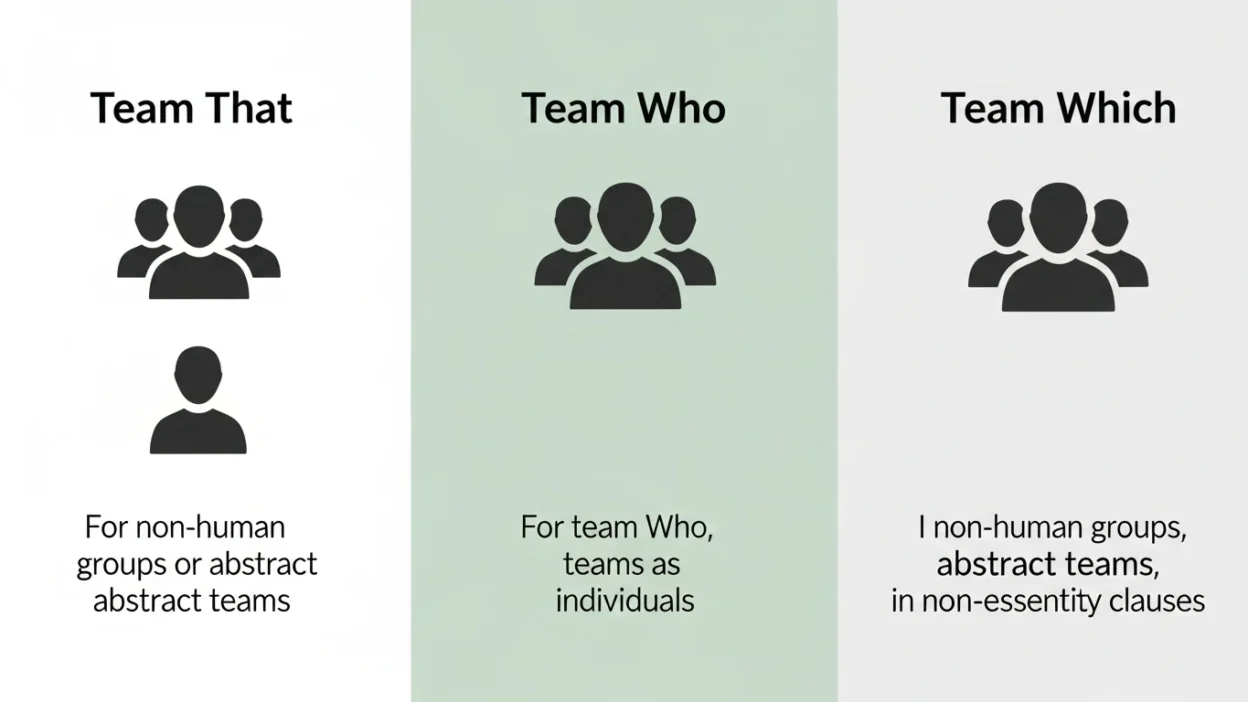
Team that treats the team as a single unit or group.
When to Use “Team That”
- General statements
- Formal or neutral tone
- When the team is acting as one unit
Examples of Team That
- The team that won the match celebrated.
- This is the team that works best together.
- A team that communicates well succeeds.
👉 This is the safest and most widely used option.
What Does “Team Who” Mean?
Team who emphasizes the individual people within the team.
When to Use “Team Who”
- When focusing on members as people
- In more conversational or British English contexts
Examples of Team Who
- The team who trained hard achieved success.
- A team who supports each other performs better.
👉 It highlights the human element.
What Does “Team Which” Mean?
Team which is grammatically possible but less natural in everyday English.
When to Use “Team Which”
- Formal or technical writing
- When treating the team as an object or entity
Examples of Team Which
- The team which was selected performed well.
👉 It can sound stiff or formal compared to that.
Team That vs Team Who vs Team Which: Key Differences
| Phrase | Usage | Tone | Commonality |
|---|---|---|---|
| Team that | Group as a unit | Neutral | Most common |
| Team who | Individuals (people) | Slightly informal | Common |
| Team which | Object/entity | Formal | Less common |
Simple Trick to Remember
Here’s an easy way to choose:
👉 That = group
👉 Who = people inside the group
Think:
- one unit → that
- individuals → who
Common Mistakes to Avoid
1. Overusing “Which”
❌ Less natural: The team which won…
✅ Better: The team that won…
2. Ignoring Context
Choose based on whether you mean the group or individuals.
3. Mixing Tone
Don’t switch between who and that randomly in the same sentence.
Real-Life Examples
Sports Context
- The team that scored first won.
Human Focus
- The team who supported each other succeeded.
Formal Writing
- The team which was selected… (less common)
American vs British English Differences
There is a slight preference:
- American English → prefers team that
- British English → more likely to use team who
👉 Still, team that works in both.
Related Words and LSI Keywords
To deepen your understanding:
- Collective nouns in English
- Who vs that vs which
- Team grammar rules
- Subject-verb agreement
- Group vs individual focus
- English relative pronouns
FAQs
Which is correct: team that or team who?
Both are correct, but team that is more common.
Can I use team who?
Yes, especially when focusing on people.
Is team which wrong?
No, but it is less natural.
Which is best for formal writing?
Team that is usually best.
What does team who emphasize?
It emphasizes the individuals.
Is there a difference in UK and US English?
Yes, UK uses team who more often.
How can I remember the rule?
Think: that = group, who = people.
Which should I use most of the time?
Use team that for safety and clarity.
Summary
The difference between team which vs team who vs team that depends on focus and tone. Team that is the most common and neutral choice, team who emphasizes individuals, and team which is more formal and less frequently used.
Understanding this helps you choose the most natural and appropriate phrase.
Final Thoughts
English gives you flexibility with collective nouns like team. By deciding whether you want to highlight the group as one unit or the people within it, you can choose the right relative pronoun.
In most cases, sticking with team that will keep your writing clear and natural.

Sarah Davis is a content writer at BibliHub.com, focused on delivering clear, organized, and easy-to-read articles. Her writing prioritizes simplicity without losing accuracy, helping readers quickly grasp key ideas. Sarah is dedicated to creating content that is informative, reliable, and suitable for a wide audience seeking practical knowledge.