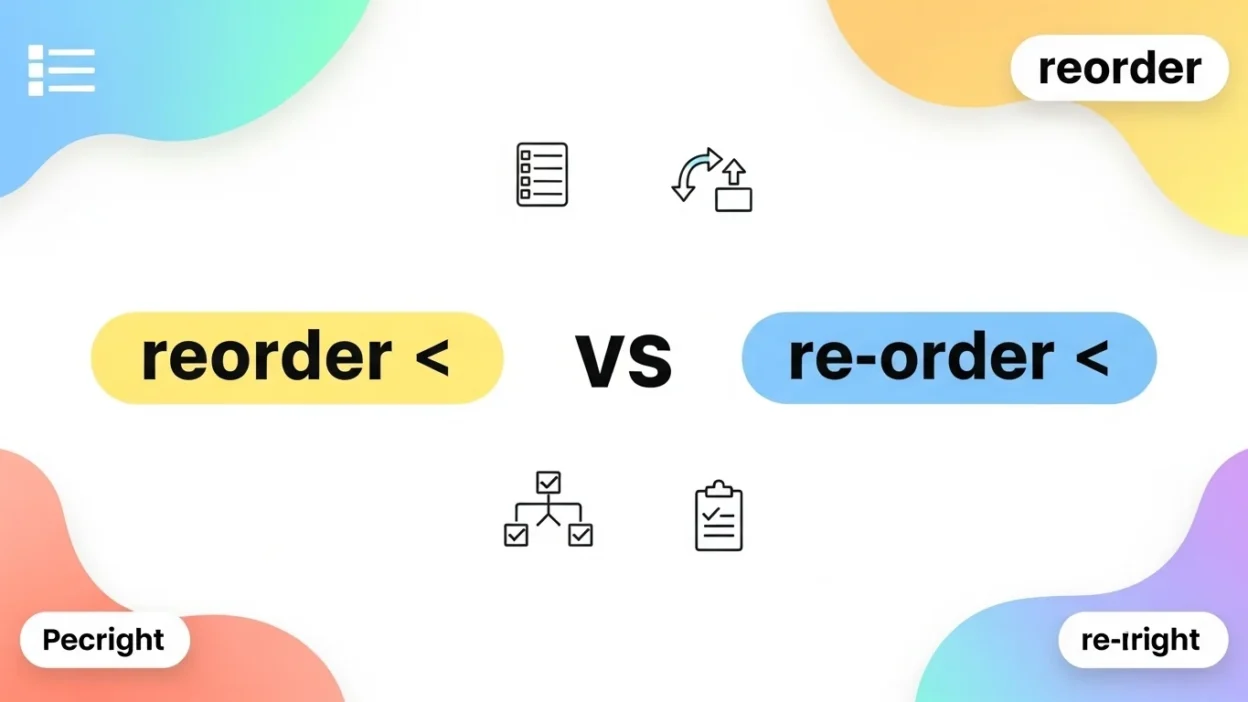
Not sure whether to write reorder or re-order? You’ll see both forms, and the right choice often depends on style, clarity, and context.
Quick Answer
- Reorder ✅ most common and preferred
- Re-order ✅ acceptable (less common, used for clarity)
👉 In short:
Use “reorder” in most cases
What Does “Reorder” Mean?
Reorder means to arrange again or place a new order.
Common Uses of Reorder
- Changing sequence or arrangement
- Ordering something again (shopping/business)
Examples of Reorder
- Please reorder the list alphabetically.
- I need to reorder supplies.
- You can reorder items online.
👉 It’s widely used in both everyday and professional writing.
What Does “Re-order” Mean?
Re-order has the same meaning, but the hyphen is sometimes added for clarity or emphasis.
When to Use “Re-order”
- To avoid confusion in complex words
- In formal or careful writing
- When readability matters
Examples of Re-order
- The items were re-ordered for clarity.
- Please re-order the sections if needed.
👉 Still correct, just less common.
Reorder vs Re-order: Key Differences
| Feature | Reorder | Re-order |
|---|---|---|
| Spelling | Closed form | Hyphenated |
| Usage | Most common | Less common |
| Clarity | Usually clear | Used for emphasis |
| Preference | Strongly preferred | Optional |
Simple Trick to Remember
Here’s an easy rule:
👉 Modern English prefers closed forms (no hyphen)
Think:
- reorder ✔
- re-order (only if needed for clarity)
Common Mistakes to Avoid
1. Overusing Hyphens
❌ re-order everything (not necessary)
✅ reorder everything
2. Being Inconsistent
Stick to one style in your writing.
3. Adding Hyphen Without Reason
Only use it when it improves clarity.
Real-Life Examples
Everyday Use
- Please reorder the items.
Business Context
- We need to reorder stock.
Editing Context
- Reorder the paragraphs for better flow.
American vs British English Differences
There is no major difference:
- Both prefer reorder
- Hyphenated form is optional in both
Related Words and LSI Keywords
To deepen your understanding:
- Reuse vs re-use
- Rebuild vs re-build
- English hyphen rules
- Compound words
- Writing style guides
- Spelling variations
FAQs
Which is correct: reorder or re-order?
Both are correct, but reorder is preferred.
When should I use re-order?
When clarity is needed or in formal contexts.
Is reorder one word?
Yes, it is commonly written as one word.
Is re-order wrong?
No, it’s acceptable but less common.
Which is more modern?
Reorder is more modern.
Is there a difference in UK and US English?
No major difference.
Should I always avoid hyphens?
No, only use them when they improve clarity.
How can I remember the rule?
Think: modern writing = no hyphen.
Summary
The difference between reorder vs re-order is mainly stylistic. Both are correct, but reorder is the more common and modern spelling, while re-order is used occasionally for clarity.
Using the preferred form keeps your writing clean and consistent.
Final Thoughts
English spelling evolves over time, and many hyphenated words become closed forms. Reorder is a good example of this trend. While re-order is still acceptable, sticking with reorder makes your writing look more natural and up to date.

Michael Brown is a contributor and author at BibliHub.com, where he produces insightful and research-oriented articles. He values depth, accuracy, and structure in his writing, ensuring that readers receive meaningful and well-supported information. Michael’s work is designed to inform, educate, and provide long-term value to readers interested in learning and exploration.