Choosing between unregister and deregister can feel confusing because both suggest removing something from a list or system. The key difference lies in formality, context, and common usage.
This guide explains unregister vs deregister clearly, with examples and practical tips.
Quick Answer
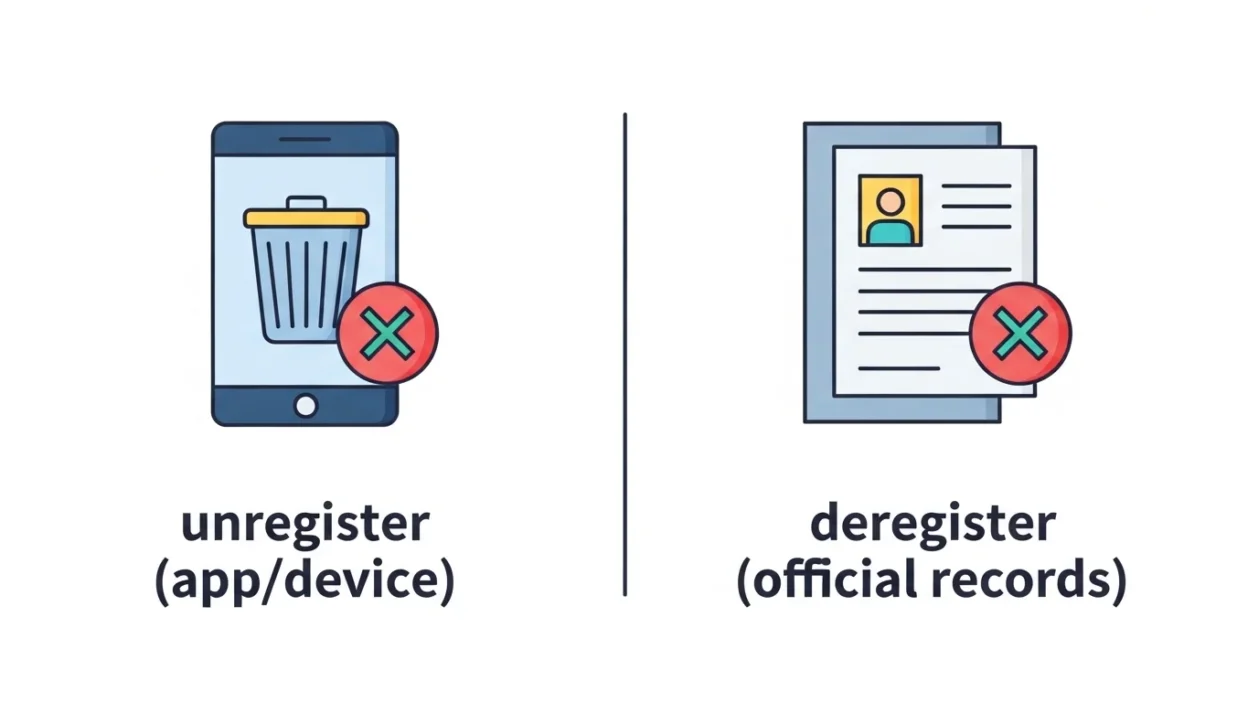
- Unregister → remove a registration (general, informal or everyday use)
- Deregister → officially remove from a register (formal/legal use)
👉 In short:
Unregister = general use
Deregister = formal/official use
What Does “Unregister” Mean?
Unregister is a verb that means to remove a registration or cancel enrollment, usually in everyday or technical contexts.
Common Uses of Unregister
- Apps and devices
- Online accounts
- Software or systems
Examples of Unregister
- Please unregister your device before selling it.
- You can unregister from the course anytime.
- He unregistered his email from the mailing list.
Synonyms for Unregister
- Remove registration
- Unsubscribe
- Disconnect
What Does “Deregister” Mean?
Deregister is a more formal term. It means to officially remove something from a register, list, or record, often in legal, business, or governmental contexts.
Common Uses of Deregister
- Companies or businesses
- Vehicles
- Official records
Examples of Deregister
- The company was deregistered after closure.
- You must deregister the vehicle before exporting it.
- The organization was deregistered by the authorities.
Synonyms for Deregister
- Remove officially
- Cancel registration
- De-list
Unregister vs Deregister: Key Differences
| Feature | Unregister | Deregister |
|---|---|---|
| Usage | General / informal | Formal / official |
| Context | Apps, accounts, devices | Legal, business, government |
| Tone | Casual | Professional |
| Example | Unregister from a website | Deregister a company |
Simple Trick to Remember
Here’s an easy way to choose:
👉 Un- = everyday removal
👉 De- = formal removal
Think:
- unregister → simple action
- deregister → official process
Common Mistakes to Avoid
1. Using “Deregister” in Casual Contexts
❌ Less natural: Deregister from the newsletter.
✅ Better: Unregister from the newsletter.
2. Using “Unregister” in Legal Contexts
❌ Incorrect: The company was unregistered by law.
✅ Correct: The company was deregistered.
3. Ignoring Tone
Match the word to the situation—formal vs informal.
Real-Life Examples
Technology Context
- Unregister your device before resetting it.
Business Context
- The firm was deregistered after bankruptcy.
Everyday Use
- I want to unregister from this service.
American vs British English Differences
There is no major difference, but:
- Deregister is commonly used in formal contexts in both US and UK
- Unregister is more common in everyday usage globally
Related Words and LSI Keywords
To deepen your understanding:
- Register vs deregister
- Unsubscribe vs unregister
- Cancel registration
- Legal terminology
- Business registration terms
- English prefixes (un- vs de-)
FAQs
What is the difference between unregister and deregister?
Unregister is general use, while deregister is formal and official.
Which is more common?
Unregister is more common in everyday language.
When should I use deregister?
Use it in legal, business, or official contexts.
Can I use unregister for a company?
It’s better to use deregister.
Are they interchangeable?
Sometimes, but not always—context matters.
Is there a difference in UK and US English?
No major difference.
How can I remember the rule?
Think: un = casual, de = formal.
Which sounds more professional?
Deregister sounds more formal and professional.
Summary
The difference between unregister vs deregister comes down to context. Unregister is used in everyday situations like apps and accounts, while deregister is used in formal or legal contexts.
Choosing the right word helps your communication sound natural and appropriate.
Final Thoughts
English prefixes like un- and de- can change tone and meaning subtly. By matching the word to the context casual or formal you can use unregister and deregister confidently.
With practice, this distinction becomes easy and intuitive.

Sarah Davis is a content writer at BibliHub.com, focused on delivering clear, organized, and easy-to-read articles. Her writing prioritizes simplicity without losing accuracy, helping readers quickly grasp key ideas. Sarah is dedicated to creating content that is informative, reliable, and suitable for a wide audience seeking practical knowledge.