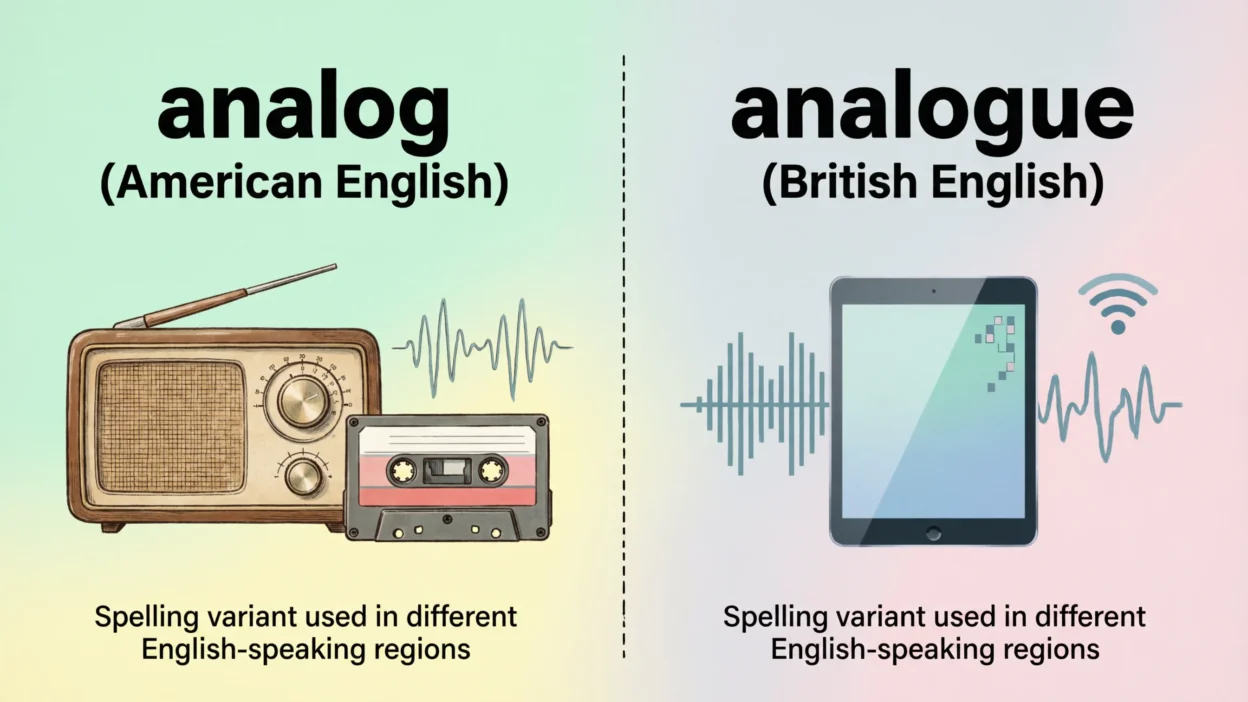
The words “analog” and “analogue” have the same meaning, but the spelling changes depending on whether you use American or British English. Both forms are widely accepted and commonly used in technology, science, electronics, and everyday communication.
Quick Answer
- Analog → American English 🇺🇸
- Analogue → British English 🇬🇧
👉 Both words mean the same thing.
What Does “Analog/Analogue” Mean?
The word refers to:
- something non-digital
- a comparison or similarity
- technology that works through continuous signals instead of digital data
It is commonly used in:
- electronics
- music equipment
- photography
- clocks and watches
- communication systems
Examples
- I prefer analog/analogue watches over digital ones.
- Vinyl records produce analog/analogue sound.
- The teacher used an analog/analogue example to explain the concept.
The meaning remains exactly the same regardless of spelling.
Why Are There Two Spellings?
The difference exists because of regional spelling conventions.
American English 🇺🇸
Uses:
✔ analog
Americans often shorten words ending in “-ogue.”
Examples:
- catalog
- dialog
- analog
British English 🇬🇧
Uses:
✔ analogue
British English usually keeps the traditional French-style “-ogue” ending.
Examples:
- catalogue
- dialogue
- analogue
Analog vs Analogue: Key Differences
| Feature | Analog | Analogue |
|---|---|---|
| Region | American English | British English |
| Meaning | Same | Same |
| Spelling Style | Shortened | Traditional |
| Usage | US technology/media | UK writing/media |
Simple Trick to Remember
👉 🇺🇸 America prefers shorter spellings → analog
👉 🇬🇧 Britain keeps “-ogue” endings → analogue
Common Uses of Analog/Analogue
1. Technology
- analog camera
- analogue recording
- analog signal
2. Timepieces
- analog clock
- analogue watch
3. Comparisons
- a modern analogue of ancient society
Analog vs Digital
People often compare analog systems with digital systems.
Analog
- continuous signals
- smoother transitions
- classic audio/video systems
Digital
- binary data (0s and 1s)
- computer-based processing
- modern electronics
Example
- Vinyl uses analog sound.
- Streaming uses digital sound.
Common Mistakes to Avoid
1. Mixing Regional Styles
If you use British spelling elsewhere, use:
✔ analogue
If you use American spelling:
✔ analog
Consistency matters in professional writing.
2. Thinking One Is Incorrect
Both spellings are correct.
3. Confusing Analog With “Analogy”
These are different words.
- analog/analogue → something similar or non-digital
- analogy → a comparison used for explanation
Real-Life Examples
American English
- The studio still uses analog equipment.
British English
- He collects analogue cameras.
Formal vs Informal Usage
Both spellings work in:
- academic writing
- technology discussions
- journalism
- casual conversation
The key difference is regional preference.
American vs British English
| American English | British English |
|---|---|
| analog | analogue |
| catalog | catalogue |
| dialog | dialogue |
FAQs
Which is correct: analog or analogue?
Both are correct.
Which spelling is American English?
Analog.
Which spelling is British English?
Analogue.
Do they mean different things?
No.
Is analog related to technology?
Yes, very commonly.
Is this a common confusion?
Yes, especially in international writing.
Summary
- Analog ✔ American spelling
- Analogue ✔ British spelling
Both words describe non-digital systems, similarities, or continuous signals.
Final Thoughts
The difference between analog and analogue is purely regional spelling preference. American English usually simplifies words by removing the “-ue” ending, while British English keeps the more traditional form. Neither spelling is more correct than the other. The best choice depends on your audience and writing style.
In technology and media, both forms remain extremely common. Whether you write analog camera or analogue camera, readers will understand the same meaning. The most important thing is consistency throughout your writing.

Emily Johnson is an author at BibliHub.com who specializes in informative and engaging content designed for everyday readers. Her writing style is approachable, organized, and focused on clarity. Emily is passionate about knowledge-sharing and aims to help readers understand topics through concise explanations, helpful examples, and a well-balanced tone that combines professionalism with readability.