These two words are closely related, but they’re used differently depending on number and context.
Quick Answer
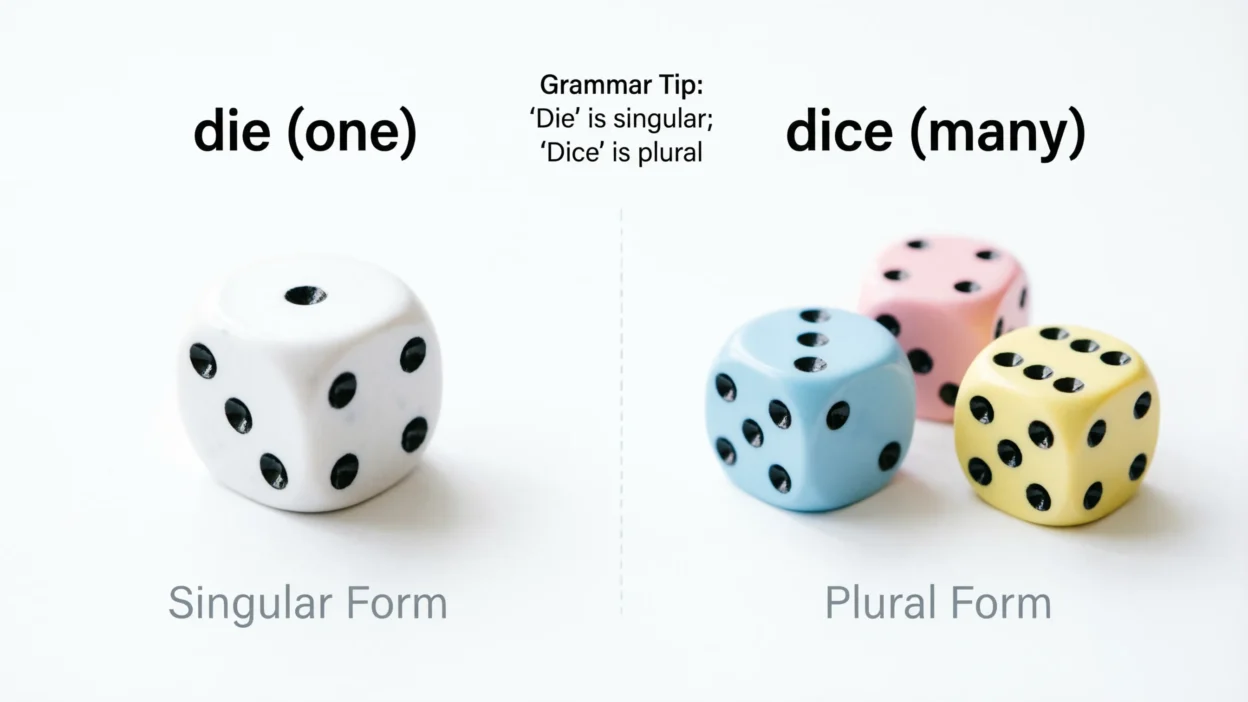
- Die → singular (one cube)
- Dice → plural (two or more cubes)
👉 In short:
Die = one 🎲
Dice = more than one 🎲🎲
What Does “Die” Mean?
A die is one small cube used in games, usually marked with numbers (1–6).
Examples
- Roll the die.
- He picked up a single die from the table.
👉 Use die when talking about one.
What Does “Dice” Mean?
Dice is the plural form of die, meaning two or more.
Examples
- Roll the dice.
- The dice landed on six and four.
👉 Use dice for multiple.
Important Note (Modern Usage)
In everyday English, many people use “dice” for both singular and plural, especially in casual speech.
- Casual: Roll the dice (even for one)
- Formal: Roll the die (correct for one)
Die vs Dice: Key Differences
| Feature | Die | Dice |
|---|---|---|
| Number | Singular | Plural |
| Meaning | One cube | Two or more cubes |
| Usage | Formal / precise | Common / everyday |
| Example | A die | Two dice |
Simple Trick to Remember
👉 Die = one
👉 Dice = many
Common Mistakes to Avoid
1. Using “Dice” for Singular (Formal Context)
❌ Roll a dice
✅ Roll a die
2. Forgetting Plural Form
❌ Two die
✅ Two dice
3. Confusing With “Die” (Verb)
⚠️ Die can also mean “to stop living”
- He will die someday. (different meaning)
Real-Life Examples
Singular
- He rolled a die and got a five.
Plural
- They rolled the dice during the game.
American vs British English
There is no difference:
- Both follow the same rule
- Casual use of “dice” for singular is common in both
FAQs
What is the difference between die and dice?
Die is singular, dice is plural.
Can dice be singular?
In informal use, yes—but formally, no.
Which is correct: roll a die or roll a dice?
Correct: roll a die
Is this a common confusion?
Yes.
Summary
- Die → one
- Dice → more than one
Final Thoughts
While modern English often uses dice for both forms, it’s best to remember the rule: die for one, dice for many especially in formal writing.

Michael Brown is a contributor and author at BibliHub.com, where he produces insightful and research-oriented articles. He values depth, accuracy, and structure in his writing, ensuring that readers receive meaningful and well-supported information. Michael’s work is designed to inform, educate, and provide long-term value to readers interested in learning and exploration.