This is a very common spelling confusion in English. Only one form is correct.
Quick Answer
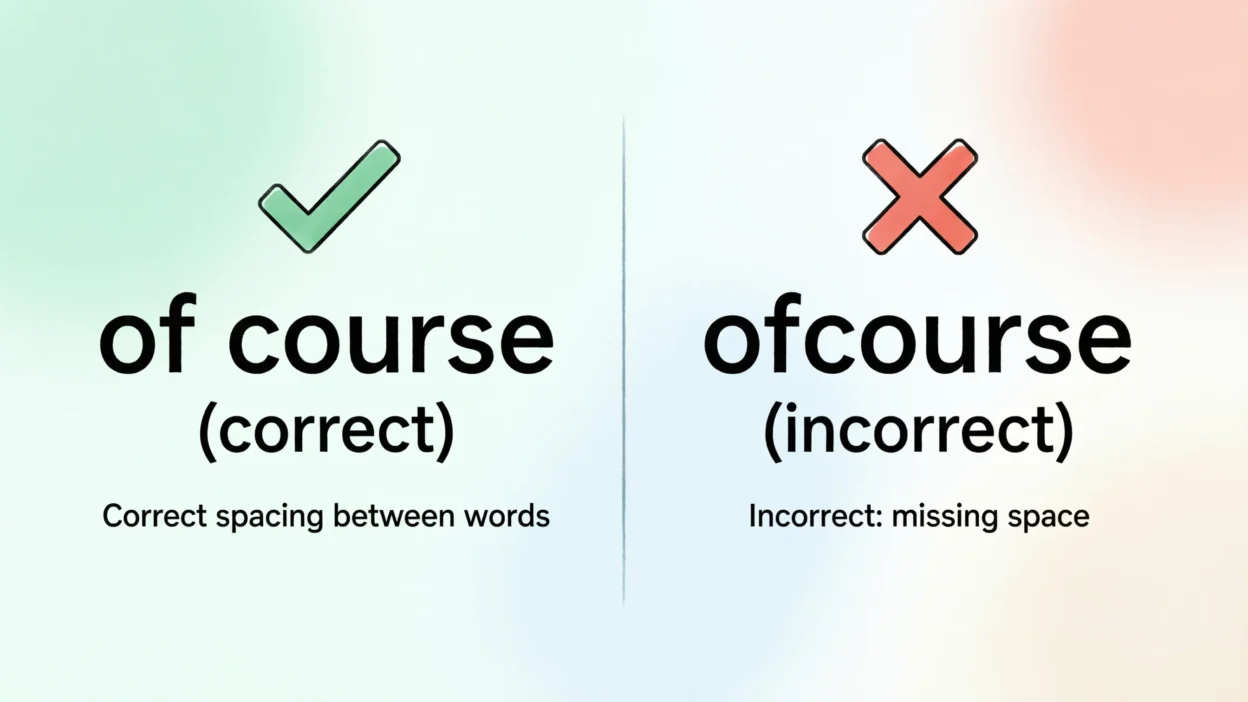
- Of course ✅ correct
- Ofcourse ❌ incorrect
👉 In short:
Always write “of course” as two separate words
What Does “Of Course” Mean?
Of course is a common English expression used to mean:
- Certainly
- Naturally
- Definitely
- Without doubt
Examples
- Of course I will help you.
- “Can you come tomorrow?” — “Of course!”
- She is of course correct.
👉 It’s used in both speaking and writing.
Why “Ofcourse” Is Wrong
❌ Ofcourse is not a standard English word.
It is simply:
- A spelling mistake
- A typing error caused by combining two words incorrectly
👉 English dictionaries and grammar guides use:
✔ of course
Of Course vs Ofcourse: Key Differences
| Feature | Of Course | Ofcourse |
|---|---|---|
| Spelling | Correct | Incorrect |
| Word Type | Phrase (two words) | ❌ Not a standard word |
| Usage | Common in English | Not accepted |
Simple Trick to Remember
👉 Think of it as:
- of + course = two separate words ✔
Common Mistakes to Avoid
1. Writing It as One Word
❌ ofcourse
✅ of course
2. Capitalization Errors
Only capitalize at the beginning of a sentence.
✔ Of course
✔ of course
3. Overusing the Phrase
Using “of course” too often can sometimes sound impatient or sarcastic depending on tone.
Real-Life Examples
- Of course you can join us.
- “Did you finish the work?” — “Of course.”
- She will of course attend the meeting.
Formal vs Informal Usage
- Common in casual conversation
- Also acceptable in formal writing
American vs British English
There is no difference:
- Both use of course
- “Ofcourse” is incorrect everywhere
FAQs
Which is correct: of course or ofcourse?
Of course is correct.
Is “ofcourse” a real word?
No.
Why do people write “ofcourse”?
Usually because of fast typing or misunderstanding.
Can “of course” be used formally?
Yes.
Is this a common mistake?
Very common.
Summary
- Of course ✔ correct
- Ofcourse ❌ incorrect
Final Thoughts
Remember that “of course” is always written as two separate words. Once you think of it as a phrase instead of one word, the spelling becomes much easier to remember.

John Miller is a content author at BibliHub.com, known for creating clear, well-structured, and reader-friendly articles. He focuses on breaking down complex topics into simple, practical explanations that are easy to understand for a global audience. John emphasizes accuracy, research-based information, and logical presentation, making his work reliable and accessible for readers seeking trustworthy knowledge.