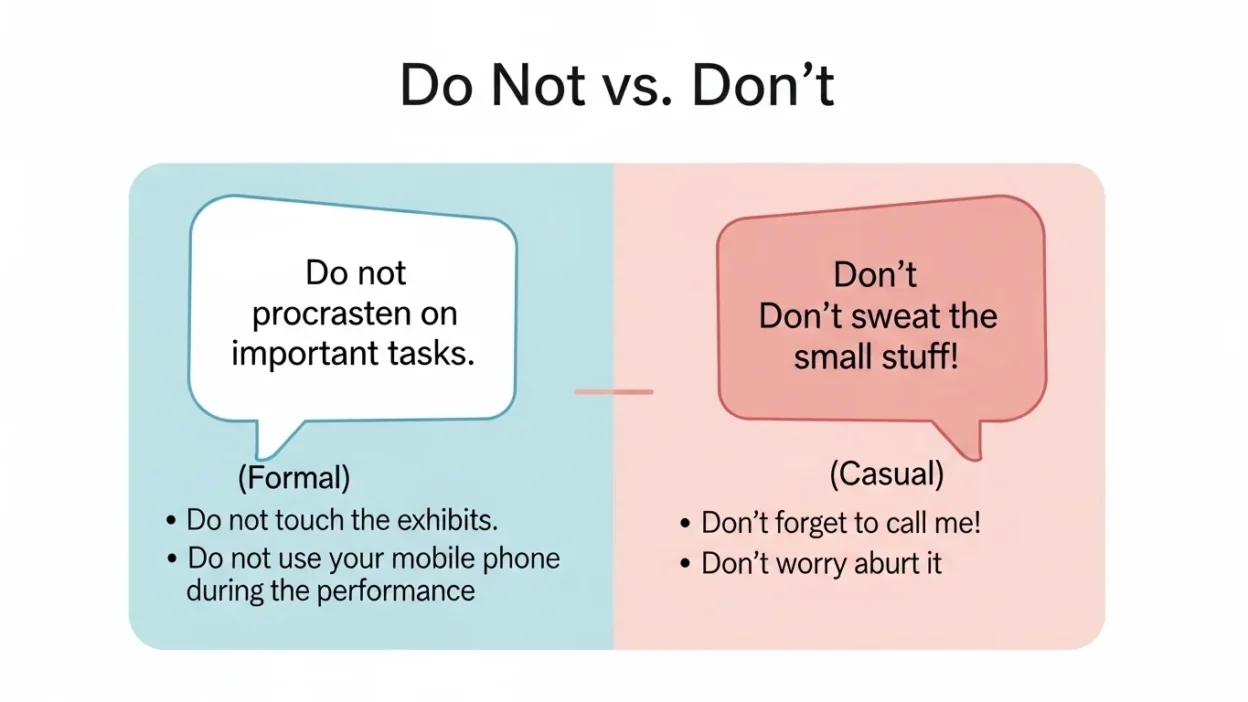
Both do not and don’t are correct—they mean the same thing. The difference is mainly about tone and formality.
Quick Answer
- Do not → formal, clear, emphasized
- Don’t → informal, natural, conversational
👉 In short:
Formal → do not
Casual → don’t
What Does “Do Not” Mean?
Do not is the full (uncontracted) form. It sounds more formal, serious, or emphatic.
When to Use “Do Not”
- Formal writing (essays, official documents)
- Instructions or warnings
- Emphasis
Examples of Do Not
- Do not enter this area.
- Please do not disturb.
- I do not agree with this decision.
👉 It adds clarity and seriousness.
What Does “Don’t” Mean?
Don’t is a contraction of do not. It’s used in everyday speech and informal writing.
When to Use “Don’t”
- Conversations
- Messages, chats, emails
- Casual writing
Examples of Don’t
- I don’t like coffee.
- Don’t worry about it.
- They don’t understand the problem.
👉 It sounds natural and friendly.
Do Not vs Don’t: Key Differences
| Feature | Do Not | Don’t |
|---|---|---|
| Form | Full form | Contraction |
| Tone | Formal / strong | Casual / relaxed |
| Usage | Writing, rules, emphasis | Speech, informal writing |
| Example | Do not enter | Don’t go there |
Simple Trick to Remember
👉 Need formality or emphasis? → do not
👉 Speaking casually? → don’t
Think:
- rules & warnings → do not
- daily talk → don’t
Common Mistakes to Avoid
1. Using “Don’t” in Formal Writing
❌ Students don’t submit late work (in formal essay)
✅ Students do not submit late work
2. Overusing “Do Not” in Casual Speech
❌ I do not like this (sounds stiff in conversation)
✅ I don’t like this
3. Confusing Tone
Choose based on situation, not just correctness.
Real-Life Examples
Formal Context
- Do not touch the equipment.
Casual Conversation
- Don’t forget your keys.
Emphasis
- I do not want this to happen again.
American vs British English
There is no major difference:
- Both use do not and don’t the same way
Related Words and LSI Keywords
- Contractions in English
- Formal vs informal writing
- Do vs does not
- Grammar basics
- English writing tips
FAQs
Which is correct: do not or don’t?
Both are correct.
When should I use do not?
In formal writing or when emphasizing.
When should I use don’t?
In casual speech and informal writing.
Is don’t unprofessional?
Not always, but avoid it in formal documents.
Do they have the same meaning?
Yes, exactly the same.
Can I use don’t in essays?
Better to use do not.
Is there a UK vs US difference?
No, usage is the same.
Is this a common confusion?
Yes, especially for learners.
Summary
The difference between do not vs don’t is about tone. Do not is formal and emphatic, while don’t is informal and conversational.
Final Thoughts
Both forms are correct, so the key is choosing the right tone for your situation. Use don’t for natural conversation and do not when you need clarity, emphasis, or formality.

Michael Brown is a contributor and author at BibliHub.com, where he produces insightful and research-oriented articles. He values depth, accuracy, and structure in his writing, ensuring that readers receive meaningful and well-supported information. Michael’s work is designed to inform, educate, and provide long-term value to readers interested in learning and exploration.