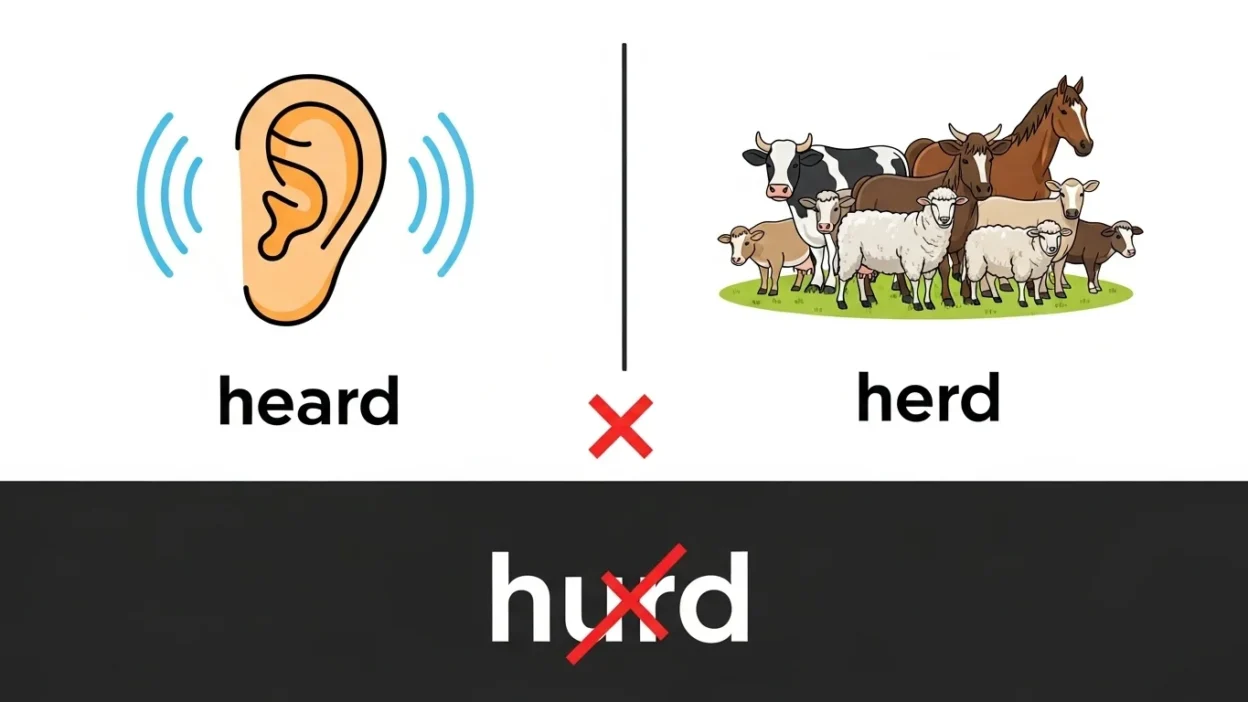
Confused between heard, herd, and hurd? You’re not alone. These words sound similar, but they have very different meanings and one of them isn’t even a standard English word.
This guide explains heard vs herd vs hurd with clear meanings, examples, and easy tips.
Quick Answer
- Heard → past tense of hear (listened)
- Herd → a group of animals
- Hurd → ❌ not a standard English word
👉 In short:
Heard = listened
Herd = animals
Hurd = incorrect
What Does “Heard” Mean?
Heard is the past tense and past participle of the verb hear. It means to have listened to or perceived sound.
Common Uses of Heard
- Listening to sounds
- Receiving information
- Being told something
Examples of Heard
- I heard a loud noise.
- She heard the news yesterday.
- Have you heard this song?
Synonyms for Heard
- Listened
- Noticed
- Detected
- Learned
What Does “Herd” Mean?
Herd is a noun (and sometimes a verb) that refers to a group of animals, especially large ones like cattle, sheep, or elephants.
Common Uses of Herd
- Groups of animals
- Managing or moving animals (verb form)
Examples of Herd
- A herd of cows crossed the road.
- The shepherd guided the herd.
- They herded the animals into the field.
Synonyms for Herd
- Group
- Flock (for birds)
- Pack (for wolves)
What About “Hurd”?
Hurd is not a correct English word in standard usage.
Why Do People Write “Hurd”?
- It’s a misspelling of “heard”
- Caused by pronunciation similarities
❌ Incorrect: I hurd a noise.
✅ Correct: I heard a noise.
Heard vs Herd vs Hurd: Key Differences
| Feature | Heard | Herd | Hurd |
|---|---|---|---|
| Meaning | Past of hear (listened) | Group of animals | ❌ Not a real word |
| Part of Speech | Verb | Noun / Verb | ❌ None |
| Example | I heard a sound | A herd of sheep | ❌ I hurd a sound |
Simple Trick to Remember
Here’s an easy way to tell them apart:
👉 Heard → has “ear” (you hear with your ear)
👉 Herd → animals stay together
Think:
- ear → heard
- animals → herd
Common Mistakes to Avoid
1. Writing “Hurd” Instead of “Heard”
❌ Incorrect: I hurd him speak.
✅ Correct: I heard him speak.
2. Confusing Sound with Animals
❌ Incorrect: I herd a noise.
✅ Correct: I heard a noise.
3. Mixing Spellings in Writing
Always double-check homophones.
Real-Life Examples
Everyday Use
- I heard the door open.
Nature Context
- A herd of elephants walked by.
Conversation
- Have you heard the news?
American vs British English Differences
There is no difference:
- Both American and British English use heard and herd the same way
- Hurd is incorrect in both
Related Words and LSI Keywords
To deepen your understanding:
- Hear vs here vs hair
- Common homophones in English
- Herd vs flock vs pack
- Listening verbs
- English spelling mistakes
- Pronunciation vs spelling
FAQs
What is the difference between heard and herd?
Heard relates to sound, while herd refers to animals.
Is hurd a real word?
No, it is a misspelling of heard.
How do I remember heard?
Think: heard has “ear” → you hear with your ear.
Can herd be a verb?
Yes, it means to gather or move animals.
Why do people confuse these words?
Because they sound very similar.
Is this the same in UK and US English?
Yes, there is no difference.
What is a herd?
A group of animals like cows or sheep.
What is the past tense of hear?
The past tense is heard.
Summary
The difference between heard vs herd vs hurd is simple. Heard is related to listening, herd refers to a group of animals, and hurd is not a correct word.
Understanding these differences helps you avoid common spelling mistakes.
Final Thoughts
Homophones like heard and herd can be confusing, but small memory tricks like linking heard to ear make them easier to remember. Avoid using hurd, as it’s not standard English.
With practice, you’ll confidently use the correct word every time.

Emily Johnson is an author at BibliHub.com who specializes in informative and engaging content designed for everyday readers. Her writing style is approachable, organized, and focused on clarity. Emily is passionate about knowledge-sharing and aims to help readers understand topics through concise explanations, helpful examples, and a well-balanced tone that combines professionalism with readability.