If you’ve ever typed infront and wondered if it’s correct, you’re not alone. This is a very common mistake in English writing. The good news? The rule is simple and easy to remember.
In this guide, you’ll learn the correct form of infront vs in front, with clear explanations, examples, and tips.
Quick Answer
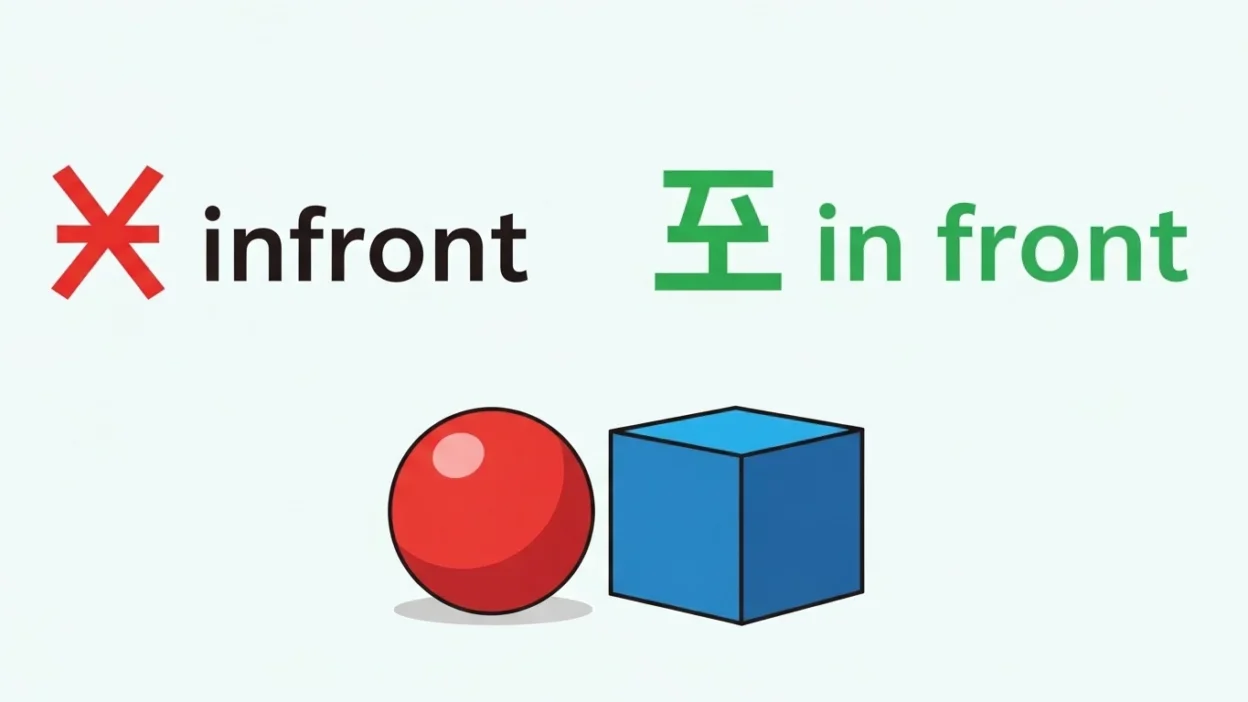
- In front ✅ is correct
- Infront ❌ is incorrect
👉 In short:
Always write it as two words: “in front.”
What Does “In Front” Mean?
In front is a phrase that means before something or ahead of someone/something.
Common Uses of In Front
- Describing position or location
- Talking about order or placement
- Giving directions
Examples of In Front
- The car is parked in front of the house.
- She stood in front of the class.
- There is a tree in front of the building.
Synonyms for In Front
- Ahead of
- Before
- In advance of
Why Is “Infront” Incorrect?
Infront is not recognized as a standard word in English. It’s a spelling mistake that happens when people combine the two words.
👉 Even though it may look natural, it should always be written as:
in + front = in front
Infront vs In Front: Key Differences
| Feature | In Front | Infront |
|---|---|---|
| Spelling | Correct | Incorrect |
| Usage | Standard English | Not accepted |
| Meaning | Ahead of something | ❌ No valid meaning |
| Example | In front of the car | ❌ Infront of the car |
Simple Trick to Remember
Here’s an easy way to avoid the mistake:
👉 If you can say “in back,” you can say “in front.”
Since “in back” is two words, “in front” should also be two words.
Common Mistakes to Avoid
1. Writing It as One Word
❌ Incorrect: He stood infront of me.
✅ Correct: He stood in front of me.
2. Confusing with Similar Words
Some words are combined (like inside), but “in front” is not one of them.
3. Fast Typing Errors
This mistake often happens when typing quickly—proofreading helps.
Real-Life Examples
Everyday Use
- The dog sat in front of the door.
School or Work
- She presented her project in front of the class.
Directions
- The shop is right in front of the bus stop.
American vs British English Differences
There is no difference between American and British English:
- Both use in front
- Infront is incorrect in both
Related Words and LSI Keywords
To deepen your understanding:
- In front of meaning
- Prepositions of place
- English spacing rules
- Common spelling mistakes
- Ahead vs before
- Location phrases
FAQs
Is infront a correct word?
No, infront is not correct in standard English.
What is the correct spelling: infront or in front?
The correct form is in front.
Why do people write infront?
Because it sounds like one word when spoken.
Can I use in front in formal writing?
Yes, it is correct in all contexts.
Is there a difference in UK and US English?
No, both use in front.
What is the opposite of in front?
The opposite is behind.
Is in front always two words?
Yes, always.
How can I remember it?
Think of similar phrases like in back—also two words.
Summary
The difference between infront vs in front is simple: only one is correct. In front is the proper two-word phrase used to describe position or location, while infront is a common spelling mistake.
Using the correct form helps your writing look clear and professional.
Final Thoughts
Small spacing errors can make a big difference in English. Remembering that “in front” is always two words will help you avoid a very common mistake.
With a little practice, this rule becomes second nature making your writing more accurate and polished.

Michael Brown is a contributor and author at BibliHub.com, where he produces insightful and research-oriented articles. He values depth, accuracy, and structure in his writing, ensuring that readers receive meaningful and well-supported information. Michael’s work is designed to inform, educate, and provide long-term value to readers interested in learning and exploration.