Confused between shown and showed? You’re not alone. These two forms of the verb show often cause confusion because they look similar but are used in different grammatical situations.
This guide will help you clearly understand shown vs showed, with simple rules, examples, and easy memory tips.
Quick Answer
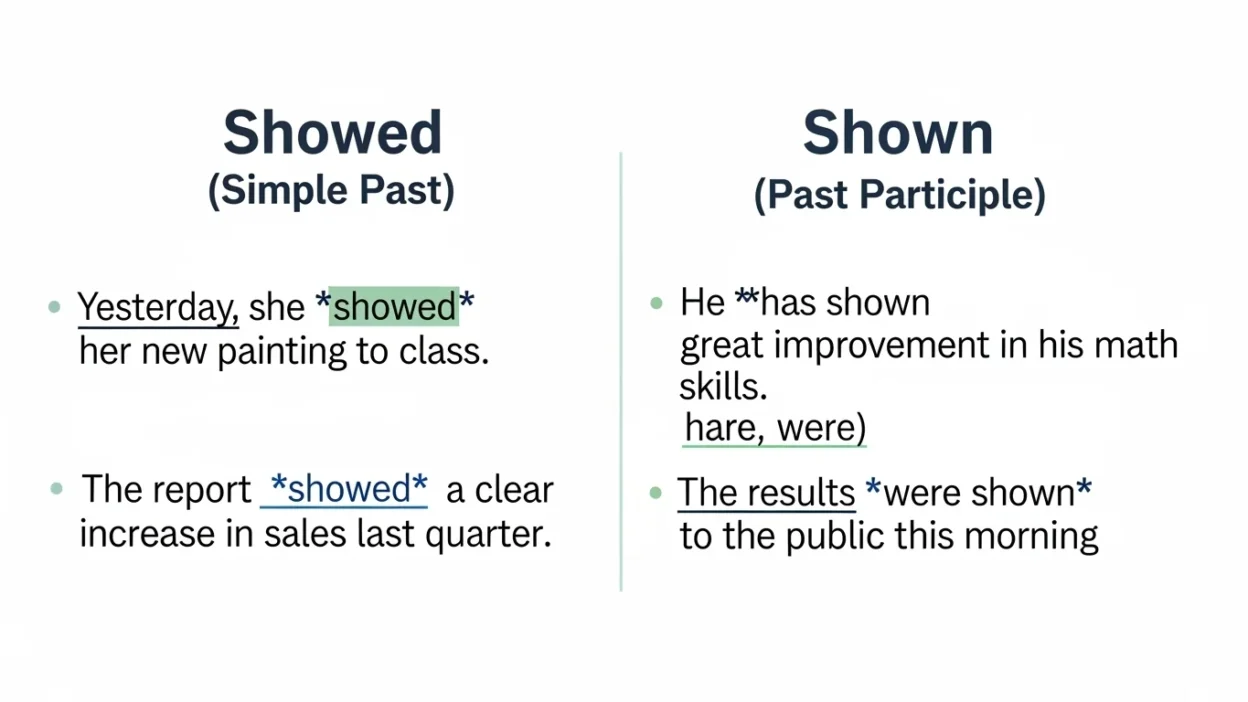
- Showed → past simple (used alone)
- Shown → past participle (used with has, have, had)
👉 In short:
Showed = past action
Shown = used with helping verbs
What Does “Showed” Mean?
Showed is the past tense of show. It describes an action that happened in the past.
When to Use “Showed”
- Without helping verbs
- For completed past actions
Examples of Showed
- She showed me her new phone.
- He showed the way to the guests.
- They showed great courage.
Synonyms for Showed
- Displayed
- Presented
- Demonstrated
- Revealed
What Does “Shown” Mean?
Shown is the past participle of show. It is used with helping verbs like has, have, had, was, were, be.
Structure
has/have/had + shown
Examples of Shown
- She has shown great improvement.
- The results have been shown clearly.
- He had shown interest before.
👉 “Shown” cannot be used alone—it needs a helping verb.
Synonyms for Shown
- Displayed
- Revealed
- Indicated
- Demonstrated
Shown vs Showed: Key Differences
| Feature | Showed | Shown |
|---|---|---|
| Verb Form | Past simple | Past participle |
| Usage | Used alone | Used with helping verbs |
| Example | She showed the photo | She has shown the photo |
| Grammar Role | Main verb | Part of perfect/passive forms |
Simple Trick to Remember
Here’s an easy way to get it right:
👉 If you see has/have/had → use “shown”
👉 If no helping verb → use “showed”
Think:
Helping verb = “shown” comes in
Common Mistakes to Avoid
1. Using “Shown” Without a Helping Verb
❌ Incorrect: She shown me the picture.
✅ Correct: She showed me the picture.
2. Using “Showed” With “Has/Have”
❌ Incorrect: He has showed interest.
✅ Correct: He has shown interest.
3. Mixing Tenses
❌ Incorrect: They have showed it yesterday.
✅ Correct: They showed it yesterday.
OR
✅ They have shown it recently.
Real-Life Examples
Everyday Conversation
- She showed me her homework.
- She has shown improvement.
Work Context
- The report showed strong results.
- The report has shown consistent growth.
Formal Context
- The study has shown significant findings.
American vs British English Differences
There is no difference between American and British English:
- Both use showed and shown the same way
- Grammar rules are identical
Related Words and LSI Keywords
To deepen your understanding:
- Show past tense
- Show past participle
- Present perfect tense
- Irregular verbs
- Grammar rules English
- Verb forms explained
FAQs
What is the difference between showed and shown?
Showed is past tense, while shown is the past participle.
Can I say “has showed”?
No, the correct form is “has shown.”
When should I use showed?
Use it for past actions without helping verbs.
When should I use shown?
Use it with has, have, had, or in passive voice.
Is “shown” always used with a helping verb?
Yes, it cannot stand alone.
Are both words correct?
Yes, but they are used in different grammatical contexts.
Is there a difference in UK and US English?
No, both use them the same way.
How can I remember the rule?
If there’s a helping verb, use shown.
Summary
The difference between shown vs showed comes down to verb forms. Showed is the past tense used on its own, while shown is the past participle used with helping verbs like has, have, or had.
Understanding this rule helps you avoid common grammar mistakes and improves your sentence accuracy.
Final Thoughts
Mastering verb forms like shown vs showed may seem small, but it makes a big difference in clear communication. Once you remember that “shown” needs a helper, choosing the correct form becomes easy.
With consistent practice, you’ll use both forms naturally and confidently in everyday English.

Sarah Davis is a content writer at BibliHub.com, focused on delivering clear, organized, and easy-to-read articles. Her writing prioritizes simplicity without losing accuracy, helping readers quickly grasp key ideas. Sarah is dedicated to creating content that is informative, reliable, and suitable for a wide audience seeking practical knowledge.