Confused between to bad and too bad? You’re not alone. These two phrases sound the same, but only one is correct in standard English.
In this guide, you’ll clearly understand too bad vs to bad, with simple explanations, examples, and easy memory tips.
Quick Answer
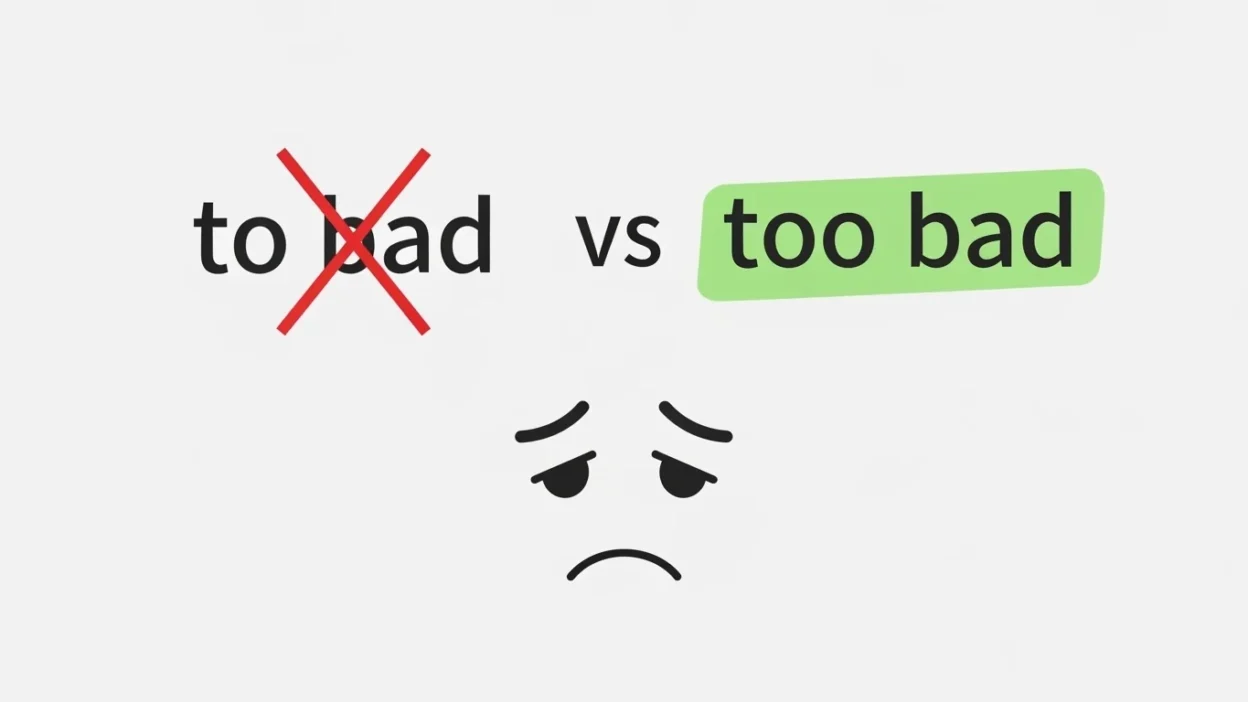
- Too bad ✅ is correct
- To bad ❌ is incorrect
👉 In short:
Always use “too bad.”
What Does “Too Bad” Mean?
Too bad is a common expression used to show regret, disappointment, or sympathy about a situation.
Common Uses of Too Bad
- Expressing disappointment
- Showing mild sympathy
- Reacting to unfortunate situations
Examples of Too Bad
- It’s too bad you missed the event.
- That’s too bad, I wanted to see you there.
- It’s too bad the weather ruined our plans.
Tone
- Casual
- Sympathetic
- Sometimes slightly dismissive (depending on context)
Why Is “To Bad” Incorrect?
To bad is not a correct phrase in English. The word to does not work in this expression.
👉 The correct form uses too, which can mean:
- excessively
- unfortunately (in this expression)
❌ Incorrect: It’s to bad you couldn’t come.
✅ Correct: It’s too bad you couldn’t come.
Too Bad vs To Bad: Key Differences
| Feature | Too Bad | To Bad |
|---|---|---|
| Spelling | Correct | Incorrect |
| Meaning | Expresses regret or disappointment | ❌ No valid meaning |
| Usage | Common in conversation | Not used |
| Example | Too bad you missed it | ❌ To bad you missed it |
Simple Trick to Remember
Here’s an easy way to get it right:
👉 “Too” has an extra “o” = extra feeling (regret/emotion)
So always use:
too bad
Common Mistakes to Avoid
1. Using “To” Instead of “Too”
❌ Incorrect: That’s to bad.
✅ Correct: That’s too bad.
2. Confusing “Too” With Direction
Remember:
- to = direction or purpose
- too = also or excessively
3. Ignoring Context
This phrase is about emotion—not direction.
Real-Life Examples
Everyday Conversation
- Too bad we couldn’t meet.
Expressing Sympathy
- That’s too bad. I hope things get better.
Casual Reaction
- Too bad you didn’t join us.
American vs British English Differences
There is no difference between American and British English:
- Both use too bad
- To bad is incorrect in both
Related Words and LSI Keywords
To strengthen understanding:
- Too vs to difference
- Expressing regret in English
- Common English mistakes
- Casual phrases
- Sympathy expressions
- English homophones
FAQs
Is “to bad” ever correct?
No, it is not correct in standard English.
What is the correct phrase?
The correct phrase is “too bad.”
What does “too bad” mean?
It expresses regret, disappointment, or sympathy.
Why do people confuse to and too?
Because they sound the same (homophones).
Can “too bad” be rude?
Sometimes, depending on tone, it can sound dismissive.
Is “too bad” formal or informal?
It is generally informal.
Can I use it in writing?
Yes, especially in casual writing or dialogue.
Is there a difference in UK and US English?
No, usage is the same.
Summary
The difference between to bad vs too bad is simple: only one is correct. Too bad is the proper phrase used to express disappointment or sympathy, while to bad is a common spelling mistake.
Understanding this helps you avoid errors and communicate more clearly.
Final Thoughts
Small spelling differences like to vs too can change the meaning of a sentence. By remembering that “too” carries emotion and emphasis, you can easily choose the correct phrase.
With practice, using too bad correctly will become natural making your English more accurate and confident.

Michael Brown is a contributor and author at BibliHub.com, where he produces insightful and research-oriented articles. He values depth, accuracy, and structure in his writing, ensuring that readers receive meaningful and well-supported information. Michael’s work is designed to inform, educate, and provide long-term value to readers interested in learning and exploration.