Confused between proved and proven? Both forms are correct but they’re used in different grammatical situations.
Quick Answer
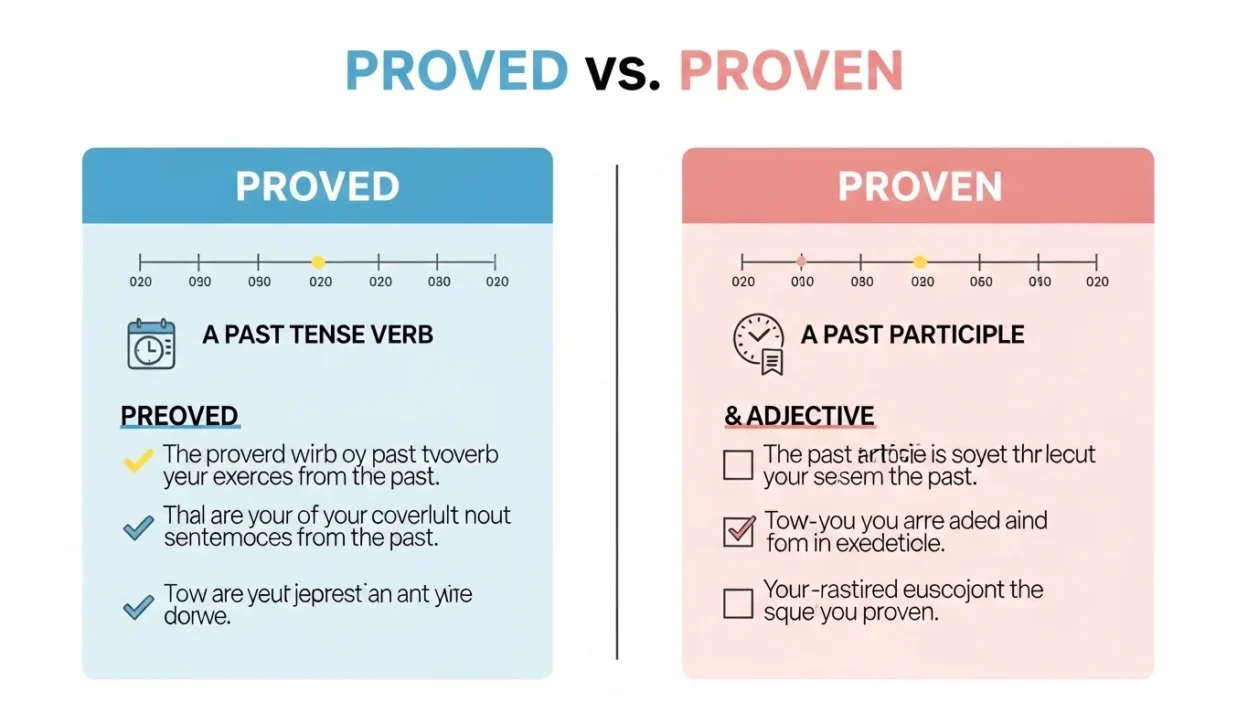
- Proved → past tense (and also past participle in standard use)
- Proven → past participle (especially in modern usage)
👉 In short:
Use “proved” for simple past
Use “proven” in perfect/passive or as an adjective
What Does “Proved” Mean?
Proved is the simple past tense of prove and is also accepted as a past participle (especially in British English).
When to Use “Proved”
- Simple past tense
- Formal or traditional usage
Examples of Proved
- He proved his point.
- She proved that the theory was correct.
👉 It describes something completed in the past.
What Does “Proven” Mean?
Proven is the past participle, commonly used in American English and modern writing. It’s also widely used as an adjective.
When to Use “Proven”
- With helping verbs (has, have, had)
- In passive voice
- As an adjective
Examples of Proven
- He has proven his skills.
- The method is proven effective.
- She had proven her ability.
👉 It often sounds more natural and modern.
Proved vs Proven: Key Differences
| Feature | Proved | Proven |
|---|---|---|
| Form | Past tense / past participle | Past participle |
| Usage | Traditional / formal | Modern / common |
| Position | Verb | Verb + adjective |
| Example | He proved it | He has proven it |
Simple Trick to Remember
👉 Past sentence alone → proved
👉 With “has/have/had” → proven (preferred)
Think:
- Yesterday → proved
- Has/have → proven
Common Mistakes to Avoid
1. Using “Proven” as Simple Past
❌ He proven the theory yesterday
✅ He proved the theory yesterday
2. Ignoring Context
Choose based on sentence structure.
3. Overthinking the Rule
Both forms are correct—focus on usage.
Real-Life Examples
Simple Past
- She proved her innocence.
Present Perfect
- She has proven her innocence.
Adjective Use
- A proven strategy works best.
American vs British English Differences
- American English → prefers proven (especially as past participle)
- British English → often uses proved in both cases
👉 Both are correct globally.
Related Words and LSI Keywords
- Prove past tense
- Prove past participle
- English verb forms
- Grammar rules
- Irregular verbs
- Has proved vs has proven
FAQs
Which is correct: proved or proven?
Both are correct, depending on usage.
When should I use proved?
For simple past tense.
When should I use proven?
In perfect tenses or as an adjective.
Is proven wrong?
No, it’s widely accepted.
Which is more common?
Proven is more common in modern English.
Is there a difference in UK and US English?
Yes, slight preference differences.
Can I use both in writing?
Yes, but stay consistent.
Is this a common confusion?
Yes, very common.
Summary
The difference between proved vs proven lies in grammar and style. Proved is used for simple past, while proven is commonly used as a past participle and adjective in modern English.
Final Thoughts
Both proved and proven are correct, but choosing the right one depends on your sentence structure. In modern usage, proven is often preferred in perfect tenses, while proved remains standard for simple past.
Mastering this distinction helps your writing sound more natural and accurate.

John Miller is a content author at BibliHub.com, known for creating clear, well-structured, and reader-friendly articles. He focuses on breaking down complex topics into simple, practical explanations that are easy to understand for a global audience. John emphasizes accuracy, research-based information, and logical presentation, making his work reliable and accessible for readers seeking trustworthy knowledge.