Confused between impatient and inpatient? You’re not alone. These two words look very similar, but they have completely different meanings and are used in very different contexts.
This guide will clearly explain impatient vs inpatient, with simple definitions, examples, and easy memory tips.
Quick Answer
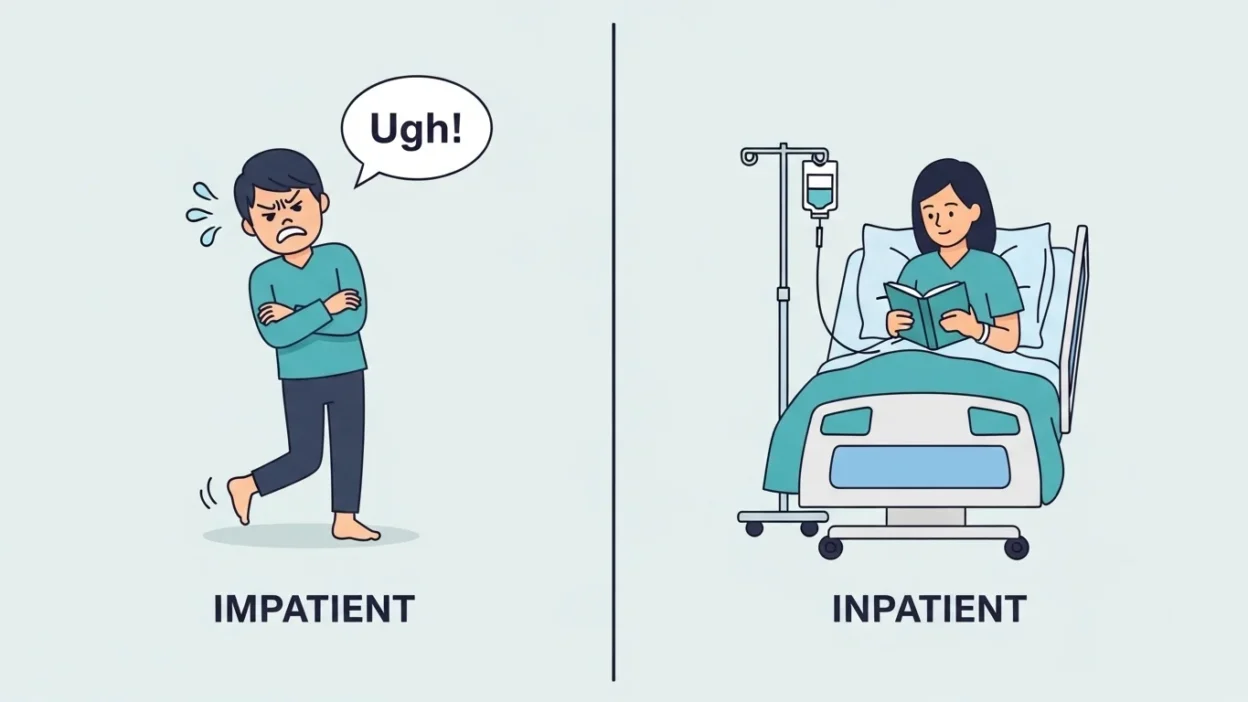
- Impatient → feeling annoyed or unable to wait
- Inpatient → a hospital patient who stays overnight
👉 In short:
Impatient = emotion
Inpatient = medical term
What Does “Impatient” Mean?
Impatient is an adjective that describes someone who feels restless, annoyed, or unable to wait calmly.
Common Uses of Impatient
- Waiting situations
- Emotional reactions
- Personality traits
Examples of Impatient
- She became impatient waiting in line.
- He is too impatient to sit still.
- The children grew impatient during the delay.
Synonyms for Impatient
- Restless
- Irritated
- Eager
- Anxious
What Does “Inpatient” Mean?
Inpatient is a noun (and sometimes adjective) used in a medical context. It refers to a person who stays in a hospital for treatment.
Common Uses of Inpatient
- Hospitals and healthcare
- Medical treatment requiring admission
Examples of Inpatient
- The doctor checked on the inpatient.
- She was admitted as an inpatient for surgery.
- The hospital has a large inpatient unit.
Synonyms for Inpatient
- Hospital patient
- Admitted patient
Impatient vs Inpatient: Key Differences
| Feature | Impatient | Inpatient |
|---|---|---|
| Meaning | Unable to wait | Hospital patient |
| Part of Speech | Adjective | Noun (mainly) |
| Context | Emotions, behavior | Medical |
| Example | I feel impatient | The inpatient needs care |
Simple Trick to Remember
Here’s an easy way to tell them apart:
👉 Impatient = “I’m patient? No!” (not patient)
👉 Inpatient = “in” the hospital
Think:
- Impatient → feeling
- Inpatient → location (in hospital)
Common Mistakes to Avoid
1. Mixing Emotional and Medical Meaning
❌ Incorrect: He is an inpatient because he can’t wait.
✅ Correct: He is impatient because he can’t wait.
2. Using “Impatient” for Hospital Context
❌ Incorrect: The impatient was treated overnight.
✅ Correct: The inpatient was treated overnight.
3. Ignoring Context
Always check:
👉 Is it about feelings or healthcare?
Real-Life Examples
Everyday Conversation
- I’m getting impatient waiting for the bus.
Medical Context
- The inpatient is recovering well.
Work Situation
- She grew impatient during the meeting.
American vs British English Differences
There is no difference:
- Both American and British English use these words the same way
- Meanings and spelling are identical
Related Words and LSI Keywords
To deepen your understanding:
- Patient vs impatient
- Outpatient vs inpatient
- Medical vocabulary
- Emotional adjectives
- Common word confusion
- English vocabulary tips
FAQs
What is the difference between impatient and inpatient?
Impatient means unable to wait, while inpatient is a hospital patient.
Is inpatient one word?
Yes, it is written as one word.
Can impatient be used as a noun?
No, it is mainly an adjective.
What is the opposite of impatient?
The opposite is patient.
What is an outpatient?
A patient who does not stay overnight in a hospital.
Are these words interchangeable?
No, they have completely different meanings.
Is there a difference in UK and US English?
No, usage is the same.
How can I remember the difference?
Think: impatient = feeling, inpatient = in hospital.
Summary
The difference between impatient vs inpatient is clear once you understand their meanings. Impatient describes a feeling of not wanting to wait, while inpatient refers to someone receiving treatment in a hospital.
Using the correct word ensures your message is clear and accurate.
Final Thoughts
Words like impatient and inpatient can be confusing because of their similar spelling, but their meanings are very different. By focusing on context emotion vs medical setting you can easily choose the right word.
With practice, this distinction becomes natural, helping you communicate more confidently and clearly.

Sarah Davis is a content writer at BibliHub.com, focused on delivering clear, organized, and easy-to-read articles. Her writing prioritizes simplicity without losing accuracy, helping readers quickly grasp key ideas. Sarah is dedicated to creating content that is informative, reliable, and suitable for a wide audience seeking practical knowledge.