Confused between sweeped and swept? You’re not alone. This is a common mistake because many English verbs form the past tense with -ed. But sweep is different it’s an irregular verb.
In this guide, you’ll learn the correct form of sweeped vs swept, with simple rules, examples, and easy tips to remember.
Quick Answer
- Swept ✅ is correct
- Sweeped ❌ is incorrect
👉 In short:
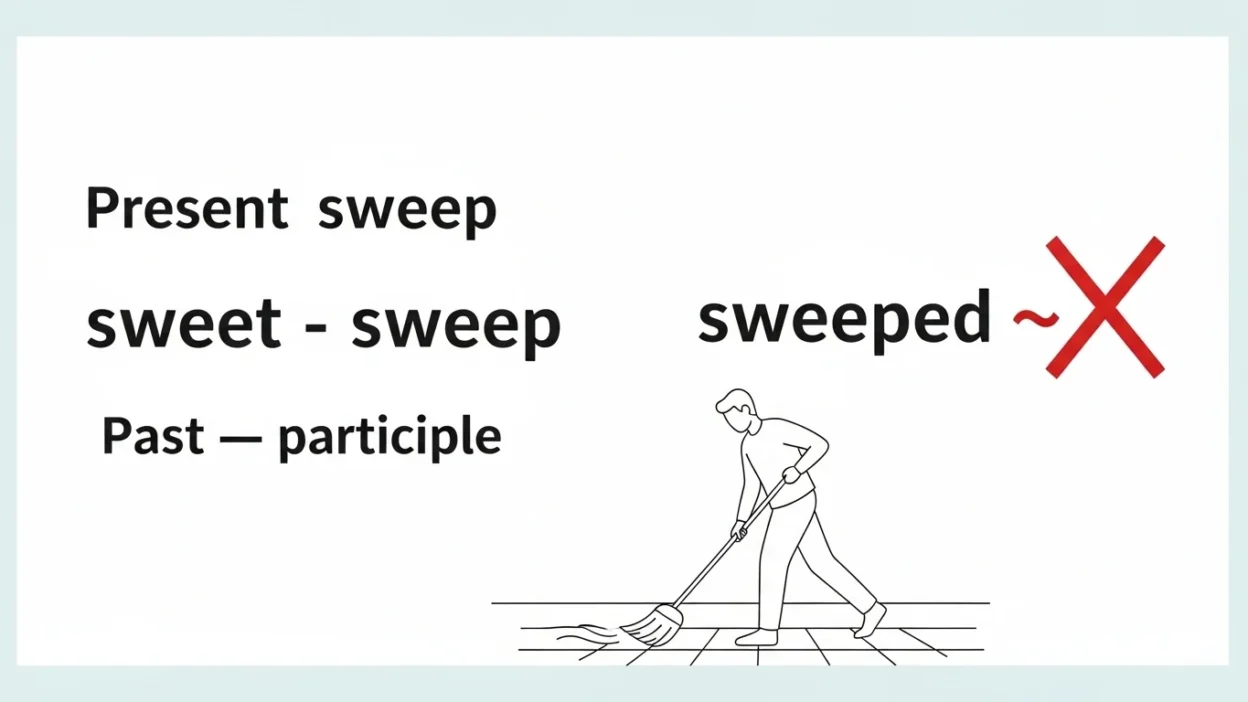
Always use “swept” as the past tense and past participle of “sweep.”
Why Is “Swept” Correct?
The verb sweep is an irregular verb, which means it does not follow the usual -ed pattern.
Verb Forms of “Sweep”
- Base form: sweep
- Past tense: swept
- Past participle: swept
👉 Unlike regular verbs, it does NOT become sweeped.
What Does “Swept” Mean?
Swept means cleaned or cleared by brushing, or moved quickly and smoothly.
Common Uses of Swept
- Cleaning (using a broom)
- Movement (fast or smooth motion)
- Emotional or figurative expressions
Examples of Swept
- She swept the floor this morning.
- The wind swept the leaves away.
- He swept into the room confidently.
Synonyms for Swept
- Cleaned
- Brushed
- Cleared
- Rushed
Why Is “Sweeped” Incorrect?
Many learners assume:
👉 sweep → sweeped
But this is wrong because sweep is irregular.
❌ Incorrect: She sweeped the floor.
✅ Correct: She swept the floor.
Sweeped vs Swept: Key Differences
| Feature | Swept | Sweeped |
|---|---|---|
| Spelling | Correct | Incorrect |
| Verb Type | Irregular past form | ❌ Not a real form |
| Usage | Standard English | Not accepted |
| Example | He swept the room | ❌ He sweeped the room |
Simple Trick to Remember
Here’s an easy way to get it right:
👉 Think: sweep → swept (just like keep → kept)
So:
- keep → kept
- sweep → swept
Common Mistakes to Avoid
1. Adding “-ed” Automatically
❌ Incorrect: They sweeped the area.
✅ Correct: They swept the area.
2. Forgetting Irregular Verb Patterns
Not all verbs follow regular rules—sweep is one of them.
3. Mixing Tenses
❌ Incorrect: She has sweeped the floor.
✅ Correct: She has swept the floor.
Real-Life Examples
Household Context
- He swept the floor after dinner.
Nature Context
- The storm swept through the city.
Figurative Use
- She was swept away by the music.
American vs British English Differences
There is no difference between American and British English:
- Both use swept
- Sweeped is incorrect in both
Related Words and LSI Keywords
To deepen your understanding:
- Sweep past tense
- Irregular verbs list
- Keep vs kept
- English verb forms
- Grammar mistakes
- Past participle examples
FAQs
Is sweeped a correct word?
No, sweeped is incorrect in standard English.
What is the past tense of sweep?
The correct past tense is swept.
Why is it swept and not sweeped?
Because sweep is an irregular verb.
Can I say “has sweeped”?
No, the correct form is “has swept.”
What is the past participle of sweep?
The past participle is swept.
Are there similar verbs?
Yes, like keep → kept.
Is this rule the same in British English?
Yes, it’s the same in both UK and US English.
How can I remember it easily?
Think: sweep → swept (not sweeped).
Summary
The difference between sweeped vs swept is simple: only one is correct. Swept is the proper past tense and past participle of sweep, while sweeped is a common mistake caused by applying regular verb rules.
Using the correct form ensures your English is accurate and natural.
Final Thoughts
Irregular verbs can be tricky, but once you learn patterns like sweep → swept, they become much easier to remember. Avoid adding -ed automatically, and instead focus on memorizing common irregular forms.
With practice, choosing swept will feel natural helping you communicate more clearly and confidently.

Emily Johnson is an author at BibliHub.com who specializes in informative and engaging content designed for everyday readers. Her writing style is approachable, organized, and focused on clarity. Emily is passionate about knowledge-sharing and aims to help readers understand topics through concise explanations, helpful examples, and a well-balanced tone that combines professionalism with readability.