Choosing between at the house and in the house can be confusing because both sound natural but they are used in different situations. The difference comes down to location vs position inside.
In this guide, you’ll learn exactly when to use each phrase with clear examples and simple rules.
Quick Answer
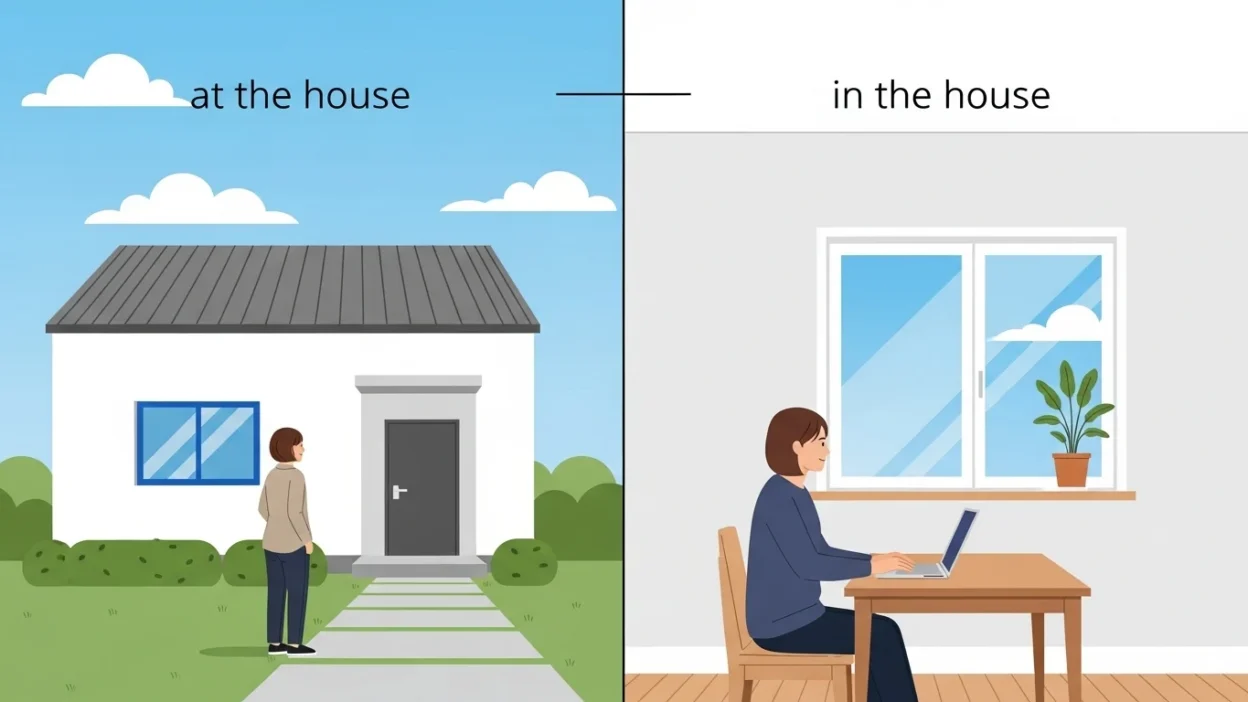
- At the house → location (general place)
- In the house → inside the building
👉 In short:
At = location
In = inside
What Does “At the House” Mean?
At the house refers to being at a location or property, not necessarily inside the building.
When to Use “At the House”
- Talking about general location
- Being near or around the house
- Not focusing on being inside
Examples of At the House
- I’m at the house right now.
- She is waiting at the house.
- We met at the house before leaving.
👉 You could be outside, in the yard, or just at the location.
What Does “In the House” Mean?
In the house means being inside the building.
When to Use “In the House”
- Talking about being indoors
- Describing something physically inside
- Emphasizing interior space
Examples of In the House
- I’m in the house watching TV.
- There’s no one in the house.
- The keys are in the house.
👉 This clearly means inside the building.
At the House vs In the House: Key Differences
| Feature | At the House | In the House |
|---|---|---|
| Meaning | General location | Inside the building |
| Focus | Place or property | Interior space |
| Example | I’m at the house | I’m in the house |
| Position | Could be outside or nearby | Definitely inside |
Simple Trick to Remember
Here’s an easy way to choose:
👉 At = address/location
👉 In = inside walls
Think:
- At the house → where you are
- In the house → where exactly inside
Common Mistakes to Avoid
1. Using “At” When You Mean Inside
❌ Incorrect: I’m at the house watching TV.
✅ Better: I’m in the house watching TV.
2. Using “In” for General Location
❌ Incorrect: Meet me in the house at 5 PM.
✅ Better: Meet me at the house at 5 PM.
3. Ignoring Context
Choose based on whether you’re talking about location or interior.
Real-Life Examples
Everyday Conversation
- I’m at the house—come over.
- I’m in the house—give me a minute.
Directions
- We’ll meet at the house.
Describing Position
- The dog is in the house.
American vs British English Differences
There is no major difference:
- Both American and British English use these phrases the same way
- The rule depends on meaning, not region
Related Words and LSI Keywords
To deepen your understanding:
- In vs at prepositions
- Prepositions of place
- At home vs in the house
- Location vs position
- English grammar tips
- Inside vs outside
FAQs
What is the difference between at the house and in the house?
At the house refers to location, while in the house means inside the building.
Can I use them interchangeably?
Not always—context determines which one is correct.
Which one is more common?
Both are common, but used in different situations.
Is “at the house” informal?
It can sound slightly casual compared to at home.
What should I say on the phone?
Usually: I’m at the house (location) or I’m in the house (inside).
Is this rule the same in UK and US English?
Yes, it’s the same in both.
Can I say “at home” instead?
Yes, at home is often more natural.
How can I remember the difference?
Think: at = location, in = inside.
Summary
The difference between at the house vs in the house is simple once you understand the context. At the house refers to a general location, while in the house clearly means being inside the building.
Choosing the right phrase helps make your meaning clearer and more precise.
Final Thoughts
Prepositions like at and in may seem small, but they play a big role in clear communication. By focusing on whether you mean location or interior space, you can easily choose the correct phrase.
With practice, this distinction becomes natural helping you speak and write English more confidently.

Sarah Davis is a content writer at BibliHub.com, focused on delivering clear, organized, and easy-to-read articles. Her writing prioritizes simplicity without losing accuracy, helping readers quickly grasp key ideas. Sarah is dedicated to creating content that is informative, reliable, and suitable for a wide audience seeking practical knowledge.