Confused between sell and sale? You’re not alone. These two words are closely related, but they belong to different parts of speech and are used in completely different ways.
In this easy guide, you’ll learn the clear difference between sell vs sale, with simple rules, examples, and memory tips.
Quick Answer
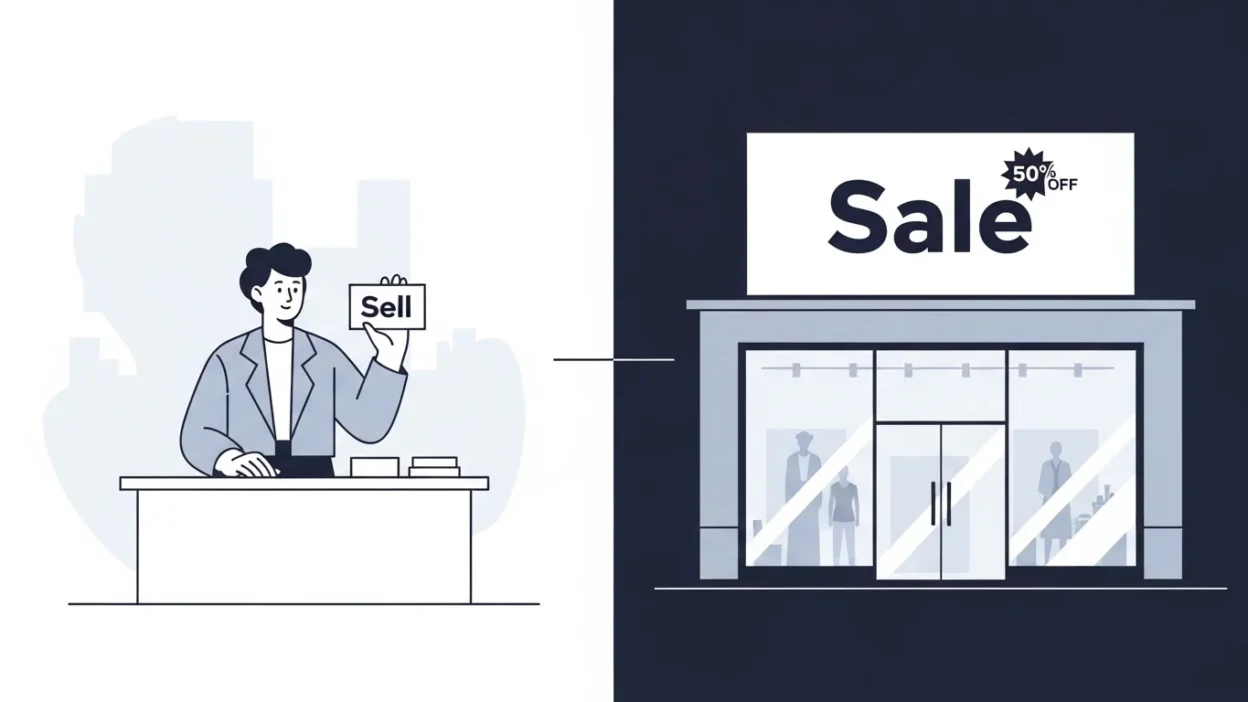
- Sell → a verb (an action)
- Sale → a noun (a thing/event)
👉 In short:
Sell = action
Sale = result/event
What Does “Sell” Mean?
Sell is a verb. It means to give something to someone in exchange for money.
Forms of “Sell”
- Base: sell
- Past: sold
- Past participle: sold
Common Uses of Sell
- Selling products or services
- Doing business transactions
Examples of Sell
- I want to sell my car.
- She sells handmade jewelry.
- They sold their house last year.
Synonyms for Sell
- Trade
- Market
- Offer
- Exchange
What Does “Sale” Mean?
Sale is a noun. It refers to the act of selling or a special event where items are sold (often at a discount).
Common Uses of Sale
- Discounts and promotions
- Business transactions
Examples of Sale
- The store is having a big sale.
- This item is for sale.
- The house is up for sale.
Synonyms for Sale
- Discount event
- Promotion
- Clearance
- Deal
Sell vs Sale: Key Differences
| Feature | Sell | Sale |
|---|---|---|
| Part of Speech | Verb | Noun |
| Meaning | To give something for money | Event or act of selling |
| Usage | Action | Thing or situation |
| Example | I sell products | The products are on sale |
Simple Trick to Remember
Here’s an easy way to keep them straight:
👉 Sell = action (verb)
👉 Sale = shop/event (noun)
Or think:
- You sell something
- You see a sale
Common Mistakes to Avoid
1. Using “Sale” as a Verb
❌ Incorrect: I want to sale my car.
✅ Correct: I want to sell my car.
2. Using “Sell” as a Noun
❌ Incorrect: The shop has a big sell.
✅ Correct: The shop has a big sale.
3. Confusing Pronunciation
They sound similar, but spelling and usage are different.
Real-Life Examples
In Business
- She sells clothes online.
- There is a sale on clothes today.
In Daily Life
- We plan to sell our old furniture.
- The furniture is on sale.
In Advertising
- Limited-time sale!
- We sell quality products.
American vs British English Differences
There is no difference between American and British English:
- Both use sell and sale the same way
- Meanings and spelling are identical
Related Words and LSI Keywords
To strengthen your understanding:
- Buy vs sell
- On sale meaning
- Selling products
- Discount sale
- Business vocabulary
- Verb vs noun examples
FAQs
What is the difference between sell and sale?
Sell is a verb (action), while sale is a noun (event or result).
Can I say “I want to sale something”?
No, the correct phrase is “I want to sell something.”
What does “on sale” mean?
It means something is being sold, often at a discounted price.
Is sale always about discounts?
Not always, but it often refers to promotional events.
What is the past tense of sell?
The past tense is sold.
Are sell and sale interchangeable?
No, they have different grammatical roles.
Is there a difference in UK and US English?
No, usage is the same.
How can I remember the difference?
Think: sell = action, sale = event.
Summary
The difference between sell vs sale is simple once you understand their roles. Sell is a verb that describes the action of giving something in exchange for money, while sale is a noun that refers to the event or result of selling.
Using the correct word helps make your sentences clear and grammatically accurate.
Final Thoughts
Even small word differences like sell and sale can change the meaning of a sentence. By remembering that one is an action and the other is a thing, you can avoid common mistakes.
With practice, choosing between sell vs sale will become natural, helping you communicate more clearly and confidently.

John Miller is a content author at BibliHub.com, known for creating clear, well-structured, and reader-friendly articles. He focuses on breaking down complex topics into simple, practical explanations that are easy to understand for a global audience. John emphasizes accuracy, research-based information, and logical presentation, making his work reliable and accessible for readers seeking trustworthy knowledge.