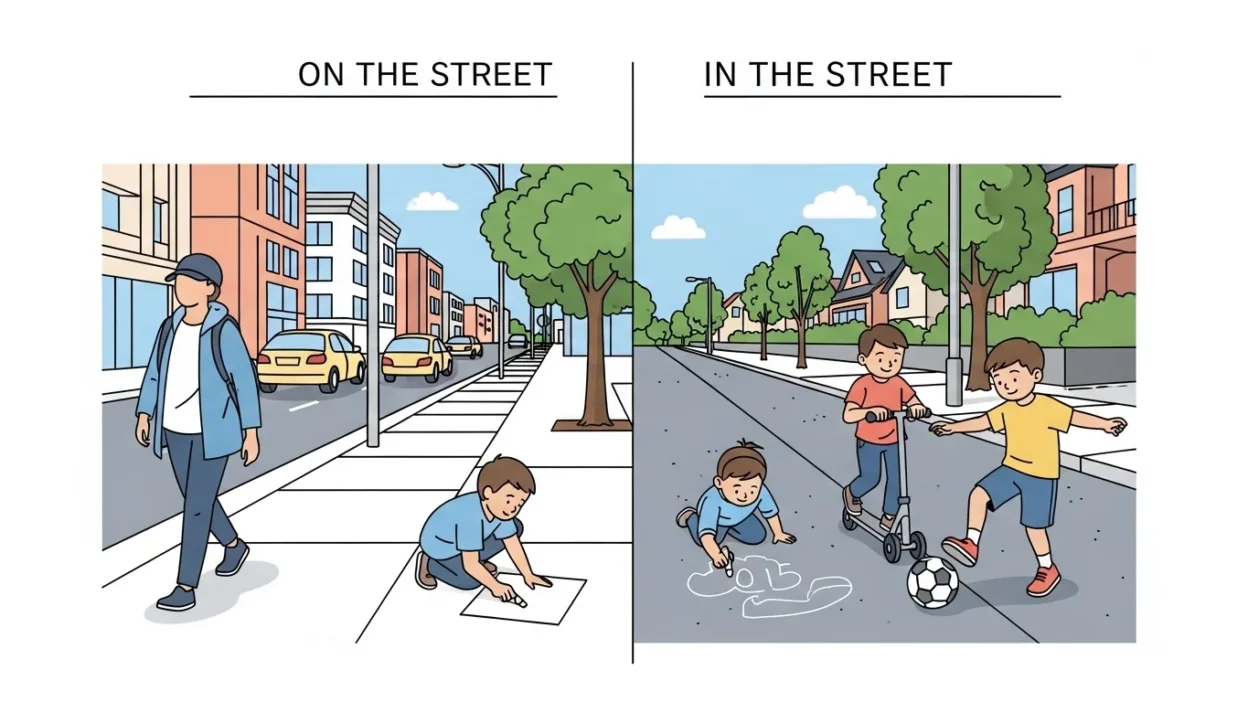
Choosing between in the street and on the street can be tricky because both are correct but they’re used in different contexts. The difference mainly depends on how you view the space (inside vs surface) and regional preference.
In this guide, you’ll learn exactly when to use in the street vs on the street, with clear examples and simple rules.
Quick Answer
- In the street → inside the street area (often British usage)
- On the street → on the surface/road (more common, especially in American English)
👉 In short:
On = surface (most common)
In = within the area (less common, more British)
What Does “On the Street” Mean?
On the street is the most common expression, especially in everyday English. It means on the surface of the road or outside in a public street area.
When to Use “On the Street”
- Talking about location in general
- Referring to being outside on a road
- Describing public or urban settings
Examples of On the Street
- There are many cars on the street.
- I saw him walking on the street.
- She lives on the street near the park.
👉 This is the safest and most natural choice in most situations.
What Does “In the Street” Mean?
In the street is used when you think of the street as an enclosed or defined space, or when emphasizing activity happening within it.
When to Use “In the Street”
- In British English (more common than in American English)
- When focusing on something happening within the street area
- In descriptive or formal contexts
Examples of In the Street
- The children were playing in the street.
- There was a parade in the street.
- People were dancing in the street.
👉 It suggests being within the street space, not just on its surface.
In the Street vs On the Street: Key Differences
| Feature | On the Street | In the Street |
|---|---|---|
| Meaning | On the surface/outside | Within the street area |
| Usage | More common | Less common |
| Region | Common in US & UK | More common in UK |
| Example | Walking on the street | Playing in the street |
Simple Trick to Remember
Here’s an easy way to choose:
👉 On = surface (default choice)
👉 In = inside the space (specific situations)
Think:
- Walking → on the street
- Activities happening within → in the street
Common Mistakes to Avoid
1. Overusing “In the Street”
❌ Less natural: I was walking in the street.
✅ Better: I was walking on the street.
2. Using “On” for Events Happening Within
❌ Awkward: They were playing on the street.
✅ Better: They were playing in the street.
3. Ignoring Context
Always consider whether you mean surface or activity within space.
Real-Life Examples
Everyday Use
- He parked his car on the street.
Activities
- Children were playing in the street.
Descriptive Writing
- Music echoed in the street during the festival.
American vs British English Differences
There is a slight preference difference:
- American English → strongly prefers on the street
- British English → uses both, but in the street is more common than in US English
👉 Still, on the street works everywhere.
Related Words and LSI Keywords
To deepen your understanding:
- Prepositions of place
- In vs on difference
- On the road vs in the road
- English grammar tips
- Location phrases
- Street vs road usage
FAQs
Which is correct: in the street or on the street?
Both are correct, but on the street is more common.
What is the difference between them?
On refers to surface, while in refers to being within the street space.
Which is more common in American English?
On the street is more commonly used.
Is “in the street” wrong?
No, it’s correct but less common in some contexts.
When should I use “in the street”?
Use it for activities happening within the street.
Can I use both in the same sentence?
Usually not—they serve different meanings.
Is this difference important?
Yes, it helps make your meaning more precise.
How can I remember it?
Think: on = surface, in = inside space.
Summary
The difference between in the street vs on the street comes down to perspective. On the street is the most common and general expression, while in the street is used when emphasizing activity within the street area.
Understanding this helps you choose the most natural and accurate phrase.
Final Thoughts
Prepositions like in and on can seem small, but they carry subtle meaning differences that improve clarity. By focusing on whether you mean surface or space, you can easily choose the right phrase.
With practice, using in the street and on the street correctly will become second nature.

Sarah Davis is a content writer at BibliHub.com, focused on delivering clear, organized, and easy-to-read articles. Her writing prioritizes simplicity without losing accuracy, helping readers quickly grasp key ideas. Sarah is dedicated to creating content that is informative, reliable, and suitable for a wide audience seeking practical knowledge.