Confused between reevaluation and re-evaluation? You’re not alone. Both forms appear in English, and the difference mainly comes down to style, clarity, and preference.
This guide explains reevaluation vs re-evaluation clearly, with examples, rules, and when to use each.
Quick Answer
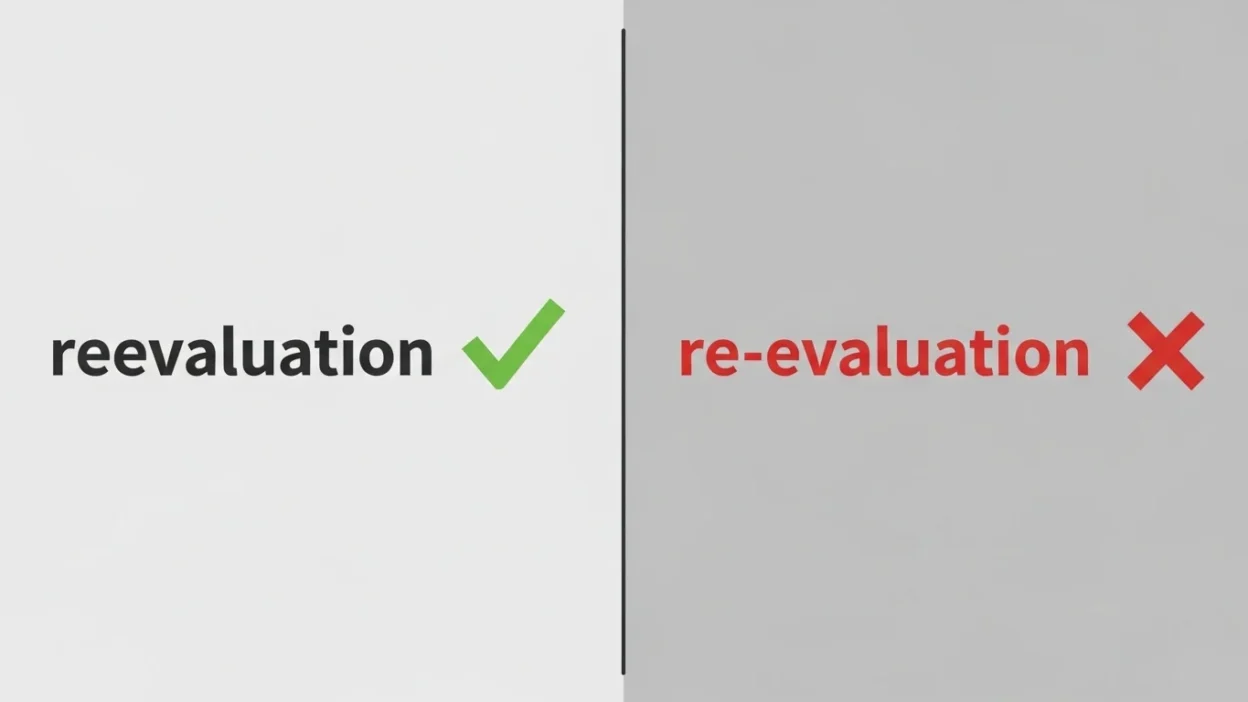
- Reevaluation ✅ preferred modern spelling
- Re-evaluation ✅ also correct (more formal or for clarity)
👉 In short:
Both are correct, but “reevaluation” is more common today
What Does “Reevaluation” Mean?
Reevaluation means examining or assessing something again.
Common Uses of Reevaluation
- Reviewing decisions
- Updating plans or strategies
- Reassessing performance or results
Examples of Reevaluation
- The company announced a reevaluation of its policies.
- After the results, a reevaluation was necessary.
- We need a reevaluation of our goals.
Synonyms for Reevaluation
- Reassessment
- Review
- Reconsideration
- Analysis
What Does “Re-evaluation” Mean?
Re-evaluation has the same meaning as reevaluation. The hyphen is simply a stylistic choice.
When to Use “Re-evaluation”
- In formal or academic writing
- When you want clearer readability
- To avoid confusion with similar-looking words
Examples of Re-evaluation
- The policy is under re-evaluation.
- A full re-evaluation of the system is required.
👉 Meaning stays exactly the same—the hyphen just improves clarity.
Reevaluation vs Re-evaluation: Key Differences
| Feature | Reevaluation | Re-evaluation |
|---|---|---|
| Spelling | One word | Hyphenated |
| Usage | Modern, common | Formal or clarity-focused |
| Meaning | Same | Same |
| Preference | More widely used today | Less common |
Simple Trick to Remember
Here’s an easy way to decide:
👉 Use “reevaluation” for simplicity
👉 Use “re-evaluation” if readability feels better
Think:
- Short & modern → reevaluation
- Clear & formal → re-evaluation
Common Mistakes to Avoid
1. Thinking One Is Wrong
❌ Incorrect: Only one form is correct
✅ Correct: Both are acceptable
2. Mixing Styles
Don’t switch between reevaluation and re-evaluation in the same document.
3. Overusing Hyphens
Modern English tends to drop unnecessary hyphens.
Real-Life Examples
Business Context
- The company began a reevaluation of its strategy.
Academic Writing
- A re-evaluation of the data was conducted.
Everyday Use
- I did a reevaluation of my plans.
American vs British English Differences
There is no major difference:
- Both American and British English accept both forms
- American English slightly favors reevaluation (no hyphen)
Related Words and LSI Keywords
To deepen your understanding:
- Reassess vs reevaluate
- Hyphen rules in English
- Reconsider meaning
- Evaluation vs assessment
- English spelling variations
- Compound words
FAQs
Is reevaluation one word or two?
It is one word in modern usage.
Is re-evaluation correct?
Yes, it is also correct.
Which form is more common?
Reevaluation (without hyphen) is more common today.
When should I use a hyphen?
Use it for clarity or in formal writing.
Are meanings different?
No, both mean the same thing.
Is this different in UK and US English?
No major difference, but US English prefers no hyphen.
Can I use both in the same document?
It’s better to stay consistent with one form.
What is a synonym for reevaluation?
Reassessment or review.
Summary
The difference between reevaluation vs re-evaluation is mainly stylistic. Both forms are correct and mean the same thing, but reevaluation is more common in modern English, while re-evaluation may be used for clarity or formality.
Choosing one and staying consistent will improve your writing.
Final Thoughts
English spelling continues to evolve, and hyphenated words often become single words over time. In the case of reevaluation, the trend favors the simpler, cleaner version.
Whether you choose reevaluation or re-evaluation, the key is clarity and consistency helping your writing stay professional and easy to read.

Michael Brown is a contributor and author at BibliHub.com, where he produces insightful and research-oriented articles. He values depth, accuracy, and structure in his writing, ensuring that readers receive meaningful and well-supported information. Michael’s work is designed to inform, educate, and provide long-term value to readers interested in learning and exploration.